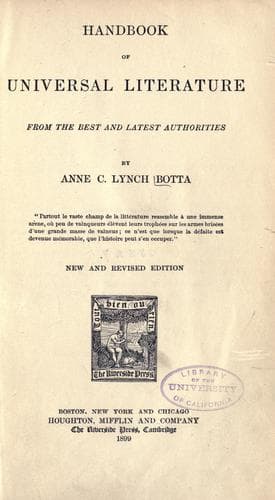
Handbook of Universal Literature, From the Best and Latest AuthoritiesBotta, Anne C. Lynch (Anne Charlotte Lynch)
History
Handbook of Universal Literature, From the Best and Latest Authorities
Botta, Anne C. Lynch (Anne Charlotte Lynch)
Literature -- History and criticism
Italian works monuments of his vast erudition and exuberant talent.
The fifteenth century closed brightly on Florence, but it was otherwise
throughout Italy. Some of its princes still patronized the sciences, but
most of them were engaged in the intrigues of ambition; and the storms
which were gathering soon burst on Florence itself. Shortly after the
death of Lorenzo, nearly the whole of Italy fell under the rule of Charles
VIII., and the voice of science and literature was drowned in the clash of
arms; military violence dispersed the learned men, and pillage destroyed
or scattered the literary treasures. Literature and the arts, banished
from their long-loved home, sought another asylum. We find them again at
Rome, cherished by a more powerful and fortunate protector, Pope Leo X.,
the son of Lorenzo (1475-1521). Though his patronage was confined to the
fine arts and to the lighter kinds of composition, yet owing to the
influence of the newly-invented art of printing, the discovery of
Columbus, and the Reformation, new energies were imparted to the age, the
Italian mind was awakened from its slumber, and prepared for a new era in
literature.
2. THE ORIGIN OF THE DRAMA AND ROMANTIC EPIC.--Among the gifted
individuals in the circle of Lorenzo, the highest rank may be assigned to
Poliziano (1454-1494). He revived on the modern stage the tragedies of the
ancients, or rather created a new kind of pastoral tragedy, on which Tasso
did not disdain to employ his genius. His "Orpheus," composed within ten
days, was performed at the Mantuan court in 1483, and may be considered as
the first dramatic composition in Italian. The universal homage paid to
Virgil had a decided influence on this kind of poetry. His Bucolics were
looked upon as dramas more poetical than those of Terence and Seneca. The
comedies of Plautus were represented, and the taste for theatrical
performances was eagerly renewed. In these representations, however, the
object in view was the restoration of the classics rather than the
amusement of the public; and the new dramatists confined themselves to a
faithful copy of the ancients. But the Orpheus of Poliziano caused a
revolution. The beauty of the verse, the charm of the music, and the
decorations which accompanied its recital, produced an excitement of
feeling and intellect that combined to open the way for the true dramatic
art.
Public-domain text, read in full here on John Shaqi.
Reviews
Reviews
No reviews yet
Be the first to share your thoughts on this work.
Elsewhere in the archive
Join the Discussion
Join the discussion
Sign in to leave a comment or review.
Sign InorCreate an account