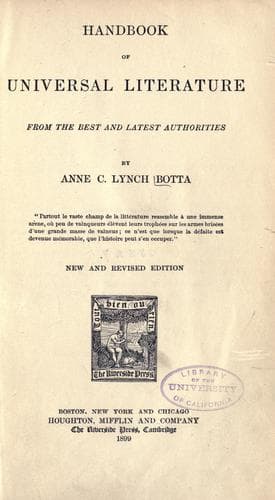
Handbook of Universal Literature, From the Best and Latest AuthoritiesBotta, Anne C. Lynch (Anne Charlotte Lynch)
History
Handbook of Universal Literature, From the Best and Latest Authorities
Botta, Anne C. Lynch (Anne Charlotte Lynch)
Literature -- History and criticism
At the same time, several eminent poets devoted their attention to that
style of composition which was destined to form the glory of Ariosto. The
trouvères chose Charlemagne and his paladins as the heroes of their poems
and romances, and these, composed for the most part in French in the
twelfth and thirteenth centuries, were early circulated in Italy. Their
origin accorded with the vivacity of the prevailing religious sentiment,
the violence of the passions and the taste for adventures which
distinguished the first crusades; while from the general ignorance of the
times, their supernatural agency was readily admitted. But at the close of
the fifteenth century, when the poets possessed themselves of these old
romances, in order to give a variety to the adventures of their heroes,
the belief in the marvelous was much diminished, and they could not be
recounted without a mixture of mockery. The spirit of the age did not
admit in the Italian language a subject entirely serious. He who made
pretensions to fame was compelled to write in Latin, and the choice of the
vulgar tongue was the indication of a humorous subject. The language had
developed since the time of Boccaccio a character of _naïveté_ mingled
with satire, which still remains, and which is particularly remarkable in
Ariosto.
The "Morgante Maggiore" of Pulci (1431-1470) is the first of these
romantic poems. It is alternately burlesque and serious, and it abounds
with passages of great pathos and beauty. The "Orlando Innamorato" of
Boiardo (1430-1494) is a poem somewhat similar to that of Pulci. It was,
however, remodeled by Berni, sixty years after the death of the author,
and from the variety and novelty of the adventures, the richness of its
descriptions, the interest excited by its hero, and the honor rendered to
the female sex, it excels the Morgante.
Public-domain text, read in full here on John Shaqi.
Reviews
Reviews
No reviews yet
Be the first to share your thoughts on this work.
Elsewhere in the archive
Join the Discussion
Join the discussion
Sign in to leave a comment or review.
Sign InorCreate an account