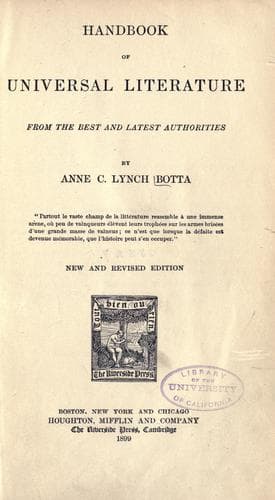
Handbook of Universal Literature, From the Best and Latest AuthoritiesBotta, Anne C. Lynch (Anne Charlotte Lynch)
History
Handbook of Universal Literature, From the Best and Latest Authorities
Botta, Anne C. Lynch (Anne Charlotte Lynch)
Literature -- History and criticism
3. ROMANTIC EPIC POETRY.--The romances of chivalry, which had been thus
versified by Pulci and Boiardo, were elevated to the rank of epic poetry
by the genius of Ariosto (1474-1533). He was born at Reggio, of which
place his father was governor. As the means of improving his resources, he
early attached himself to the service of Cardinal D'Este, and afterwards
to that of the Duke of Ferrara. At the age of thirty years he commenced
his "Orlando Furioso," and continued the composition for eleven years.
While the work was in progress, he was in the habit of reading the cantos,
as they were finished, at the courts of the cardinal and duke, which may
account for the manner in which this hundred-fold tale is told, as if
delivered spontaneously before scholars and princes, who assembled to
listen to the marvelous adventures of knights and ladies, giants and
magicians, from the lips of the story-teller. Ariosto excelled in the
practice of reading aloud with distinct utterance and animated elocution,
an accomplishment of peculiar value at a time when books were scarce, and
the emoluments of authors depended more on the gratuities of their patrons
than the sale of their works. In each of the four editions which he
published, he improved, corrected, and enlarged the original. No poet,
perhaps, ever evinced more fastidious taste in adjusting the nicer points
that affected the harmony, dignity, and fluency of his composition, yet
the whole seems as natural as if it had flowed extemporaneously from his
pen. Throughout life it was the lot of Ariosto to struggle against the
difficulties inseparable from narrow and precarious circumstances. His
patrons, among them Leo X., were often culpable in exciting expectations,
and afterwards disappointing them. The earliest and latest works of
Ariosto, though not his best, were dramatic. He wrote also some satires in
the form of epistles. He died in the fifty-eighth year of his age, and his
ashes now rest under the magnificent monument in the new church of the
Benedictines in Ferrara. The house in which the poet lived, the chair in
which he was wont to study, and the inkstand whence he filled his pen, are
still shown as interesting memorials of his life and labors.
Public-domain text, read in full here on John Shaqi.
Reviews
Reviews
No reviews yet
Be the first to share your thoughts on this work.
Elsewhere in the archive
Join the Discussion
Join the discussion
Sign in to leave a comment or review.
Sign InorCreate an account