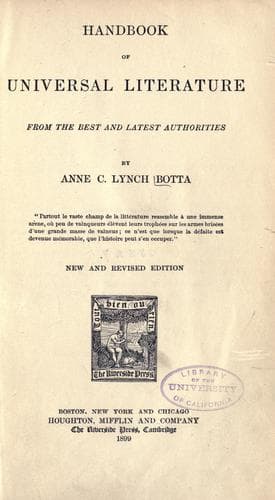
Handbook of Universal Literature, From the Best and Latest AuthoritiesBotta, Anne C. Lynch (Anne Charlotte Lynch)
History
Handbook of Universal Literature, From the Best and Latest Authorities
Botta, Anne C. Lynch (Anne Charlotte Lynch)
Literature -- History and criticism
Ariosto, like Pulci and Boiardo, undertook to sing the paladins and their
amours at the court of Charlemagne, during the fabulous wars of this
emperor against the Moors. In his poem he seems to have designedly thrown
off the embarrassment of a unity of action. The Orlando Furioso is founded
on three principal narratives, distinct but often intermingled; the
history of the war between Charlemagne and the Saracens, Orlando's love
for Angelica, his madness on hearing of her infidelity, and Ruggiero's
attachment to Bradamante. These stories are interwoven with so many
incidents and episodes, and there is in the poem such a prodigious
quantity of action, that it is difficult to assign it a central point.
Indeed, Ariosto, playing with his readers, seems to delight in continually
misleading them, and allows them no opportunity of viewing the general
subject of the poem. This want of unity is essentially detrimental to the
general impression of the work, and the author has succeeded in throwing
around its individual parts an interest which does not attach to it as a
whole. The world to which the poet transports his readers is truly poetic;
all the factitious wants of common life, its cold calculations and its
imaginary distinctions, disappear; love and honor reign supreme, and the
prompting of the one and the laws of the other are alone permitted to
stimulate and regulate a life, of which war is the only business and
gallantry the only pastime. The magic and sorcery, borrowed from the East,
which pervade these chivalric fictions, lead us still farther from the
world of realities. Nor is it the least charm that all the wonders and
prodigies here related are made to appear quite probable from the
apparently artless, truthful style of the narration. The versification of
the Orlando is more distinguished for sweetness and elegance than for
strength; but, in point of harmony, and in the beauty, pathos, and grace
of his descriptions, no poet surpasses Ariosto.
4. HEROIC EPIC POETRY.--While, in the romantic epic of the Middle Ages,
unity of design was considered unnecessary, and truthfulness of detail,
fertility of imagination, strength of coloring, and vivacity of narration
were alone required, heroic poetry was expected to exhibit, on the most
extensive scale, those laws of symmetry which adapt all the parts to one
object, which combine variety with unity, and, as it were, initiate us
into the secrets of creation, by disclosing the single idea which governs
the most dissimilar actions, and harmonizes the most opposite interests.
It was reserved to Torquato Tasso to raise the Italian language to this
kind of epic poetry.
Public-domain text, read in full here on John Shaqi.
Reviews
Reviews
No reviews yet
Be the first to share your thoughts on this work.
Elsewhere in the archive
Join the Discussion
Join the discussion
Sign in to leave a comment or review.
Sign InorCreate an account