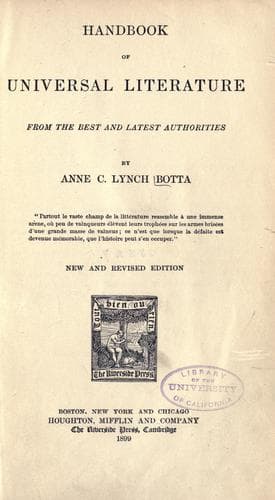
Handbook of Universal Literature, From the Best and Latest AuthoritiesBotta, Anne C. Lynch (Anne Charlotte Lynch)
History
Handbook of Universal Literature, From the Best and Latest Authorities
Botta, Anne C. Lynch (Anne Charlotte Lynch)
Literature -- History and criticism
Tasso (1544-1595) was born in Sorrento, and many marvels are told by his
biographers of the precocity of his genius. Political convulsions early
drove his father into exile. He went to Rome and sent for his son, then
ten years of age. When the exiles were no longer safe at Rome, an asylum
was offered them at Pesaro by the Duke of Urbino. Here young Tasso pursued
his studies in all the learning and accomplishments of the age. In his
seventeenth year he had completed the composition of an epic poem on the
adventures of Rinaldo, which was received with passionate admiration
throughout Italy. The appearance of this poem proved not only the
beginning of the author's fame, but the dawn of a new day in Italian
literature. In 1565, Tasso was nominated by the Cardinal D'Este as
gentleman of his household, and his reception at the court was in every
respect most pleasing to his youthful ambition. He was honored by the
intimate acquaintance of the accomplished princesses Lucretia and Leonora,
and to this dangerous friendship must be attributed most of his subsequent
misfortunes, if it be true that he cherished a secret attachment for
Leonora.
During this prosperous period of his life, Tasso prosecuted his great epic
poem, the "Jerusalem Delivered," and as canto after canto was completed
and recited to the princesses, he found in their applause repeated
stimulus to proceed. While steadily engaged in his great work, his fancy
gave birth to numerous fugitive poems, the most remarkable of which is the
"Aminta." After its representation at the court of Ferrara, all Italy
resounded with the poet's fame. It was translated into all the languages
of Europe, and the name of Tasso would have been immortal even though he
had never composed an epic. The various vexations he endured regarding the
publication of his work at its conclusion, the wrongs he suffered from
both patrons and rivals, together with disappointed ambition, rendered him
the subject of feverish anxiety and afterwards the prey of restless fear
and continual suspicion. His mental malady increased, and he wandered from
place to place without finding any permanent home. Assuming the disguise
of a shepherd, he traveled to Sorrento, to visit his sister; but soon,
tired of seclusion, he obtained permission to return to the court of
Ferrara. He was coldly received by the duke, and was refused an interview
with the princesses. He left the place in indignation, and wandered from
one city of Italy to another, reduced to the appearance of a wretched
itinerant, sometimes kindly received, sometimes driven away as a vagabond,
always restless, suspicious, and unhappy. In this mood he again returned
to Ferrara, at a moment when the duke was too much occupied with the
solemnities of his own marriage to attend to the complaints of the poet.
Tasso became infuriated, retracted all the praises he had bestowed on the
house of Este, and indulged in the bitterest invectives against the duke,
Public-domain text, read in full here on John Shaqi.
Reviews
Reviews
No reviews yet
Be the first to share your thoughts on this work.
Elsewhere in the archive
Join the Discussion
Join the discussion
Sign in to leave a comment or review.
Sign InorCreate an account