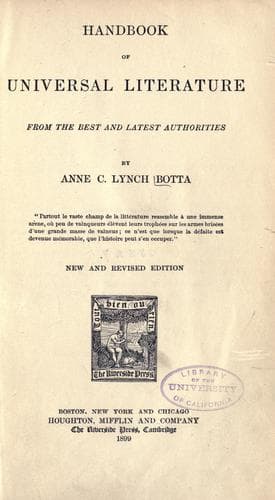
Handbook of Universal Literature, From the Best and Latest AuthoritiesBotta, Anne C. Lynch (Anne Charlotte Lynch)
History
Handbook of Universal Literature, From the Best and Latest Authorities
Botta, Anne C. Lynch (Anne Charlotte Lynch)
Literature -- History and criticism
by whose orders he was afterwards committed to the hospital for lunatics,
where he was closely confined, and treated with extreme rigor. If he had
never been insane before, he certainly now became so. To add to his
misfortune, his poem was printed without his permission, from an imperfect
copy, and while editors and printers enriched themselves with the fruit of
his labors, the poet himself was languishing in a dungeon, despised,
neglected, sick, and destitute of the common conveniences of life, and
above all, deafened by the frantic cries with which the hospital
continually resounded. When the first rigors of his imprisonment were
relaxed, Tasso pursued his studies, and poured forth his emotions in every
form of verse. Some of his most beautiful minor poems were composed during
this period. After more than seven years' confinement, the poet was
liberated at the intercession of the Duke of Mantua. Prom this time he
wandered from city to city; the hallucinations of his mind never entirely
ceased. Towards the close of the year 1594 he took up his residence at
Rome, where he died at the age of fifty-two.
Tasso was particularly happy in choosing the most engaging subject that
could inspire a modern poet--the struggle between the Christians and the
Saracens. The Saracens considered themselves called on to subjugate the
earth to the faith of Mohammed; the Christians to enfranchise the sacred
spot where their divine founder suffered death. The religion of the age
was wholly warlike. It was a profound, disinterested, enthusiastic, and
poetic sentiment, and no period has beheld such a brilliant display of
valor. The belief in the supernatural, which formed a striking
characteristic of the time, seemed to have usurped the laws of nature and
the common course of events.
The faith against which the crusaders fought appeared to them the worship
of the powers of darkness. They believed that a contest might exist
between invisible beings as between different nations, and when Tasso
armed the dark powers of enchantment against the Christian knights, he
only developed and embellished a popular idea.
The scene of the Jerusalem Delivered, so rich in recollections and
associations with all our religious feelings, is one in which nature
displays her riches and treasures, and where descriptions, in turn the
most lovely and the most austere, attract the pen of the poet. All the
nations of Christendom send forth their warriors to the army of the cross,
and the whole world thus becomes his patrimony. Whatever interest the
taking of Troy might possess for the Greeks, or the vanity of the Romans
might attach to the adventures of AEneas, whom they adopted as their
progenitor, it may be asserted that neither the Iliad nor the Aeneid
possesses the dignity of subject, the interest at the same time divine and
human, and the varied dramatic action which are peculiar to the Jerusalem
Delivered.
Public-domain text, read in full here on John Shaqi.
Reviews
Reviews
No reviews yet
Be the first to share your thoughts on this work.
Elsewhere in the archive
Join the Discussion
Join the discussion
Sign in to leave a comment or review.
Sign InorCreate an account