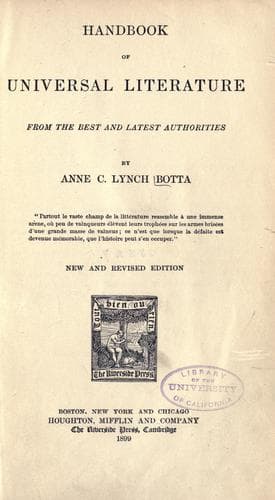
Handbook of Universal Literature, From the Best and Latest AuthoritiesBotta, Anne C. Lynch (Anne Charlotte Lynch)
History
Handbook of Universal Literature, From the Best and Latest Authorities
Botta, Anne C. Lynch (Anne Charlotte Lynch)
Literature -- History and criticism
The whole course of the poem is comprised in the campaign of 1093, when
the Christian army, assembled on the plain of Tortosa, marched towards
Jerusalem, which they besieged and captured. From the commencement of the
poem, the most tender sentiments are combined with the action, and love
has been assigned a nobler part than had been given to it in any other
epic poem. Love, enthusiastic, respectful, and full of homage, was an
essential characteristic of chivalry and the source of the noblest
actions. While with the heroes of the classic epic it was a weakness, with
the Christian knights it was a devotion. In this work are happily combined
the classic and romantic styles. It is classic in its plan, romantic in
its heroes; it is conceived in the spirit of antiquity, and executed in
the spirit of medieval romance. It has the beauty which results from unity
of design and from the harmony of all its parts, united with the romantic
form, which falls in with the feelings, the passions, and the
recollections of Europeans. Notwithstanding some defects, which must be
attributed rather to the taste of his age than to his genius, in the
history of literature Tasso may be placed by the side of Homer and Virgil.
5. LYRIC POETRY.--Lyric poetry, which had been brought to such perfection
by Petrarch in the fourteenth century, but almost lost sight of in the
fifteenth, was cultivated by all the Italian poets of this period.
Petrarch became the model, which every aspirant endeavored to imitate.
Hence arose a host of poetasters, who wrote with considerable elegance,
but without the least power of imagination. We must not, however, confound
with the servile imitators of Petrarch those who took nothing from his
school but purity of language and elegance of style, and who consecrated
the lyre not to love alone, but to patriotism and religion. First of these
are Poliziano and Lorenzo de' Medici, in whose ballads and stanzas the
language of Petrarch reappeared with all its beauty and harmony. Later,
Cardinal Bembo (1470-1547), Molza (1489-1544), Tarsia (1476-1535),
Guidiccioni (1480-1541), Della Casa (1503-1556), Costanzo (1507-1585), and
later still, Chiabrera (1552-1637), attempted to restore Italian poetry to
its primitive elegance. Their sonnets and canzoni contributed much to the
revival of a purer style, although their elegance is often too elaborate
and their thoughts and feelings too artificial. Besides these, Ariosto,
Tasso, Machiavelli, and Michael Angelo, whose genius was practiced in more
ambitious tasks, did not disdain to shape and polish such diminutive gems
as the canzone, the madrigal, and the sonnet.
Public-domain text, read in full here on John Shaqi.
Reviews
Reviews
No reviews yet
Be the first to share your thoughts on this work.
Elsewhere in the archive
Join the Discussion
Join the discussion
Sign in to leave a comment or review.
Sign InorCreate an account