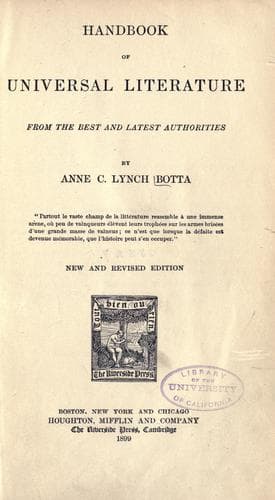
Handbook of Universal Literature, From the Best and Latest AuthoritiesBotta, Anne C. Lynch (Anne Charlotte Lynch)
History
Handbook of Universal Literature, From the Best and Latest Authorities
Botta, Anne C. Lynch (Anne Charlotte Lynch)
Literature -- History and criticism
This reform of taste in lyric composition was also promoted by several
women, among whom the most distinguished at once for beauty, virtue, and
talent was Vittoria Colonna (1490-1547). She was daughter of the high
constable of Naples, and married to the Marquis of Pescara. Early left a
widow, she abandoned herself to sorrow. That fidelity which made her
refuse the hand of princes in her youth, rendered her incapable of a
second attachment in her widowhood. The solace of her life was to mourn
the loss and cherish the memory of Pescara. After passing several years in
retirement, Vittoria took up her residence at Rome, and became the
intimate friend of the distinguished men of her time. Her verses, though
deficient in poetic fancy, are full of tenderness and absorbing passion.
Vittoria Colonna was reckoned by her contemporaries as a being almost more
than human, and the epithet divine was usually prefixed to her name. By
her death-bed stood Michael Angelo, who was considerably her junior, but
who enjoyed her friendship and regarded her with enthusiastic veneration.
He wrote several sonnets in her praise. Veronica Gambara, Tullia
d'Aragona, and Giulia Gonzaga may also be named as possessing superior
genius to many literary men of their time.
6. DRAMATIC POETRY.--Tragedy, in the hands of the Romans, had exhibited no
national characteristics, and disappeared with the decline of their
literature. When Europe began to breathe again, the natural taste of the
multitude for games and spectacles revived; the church entertained the
people with its representations, which, however, were destitute of all
literary character. At the commencement of the fourteenth century we find
traces of Latin tragedies, and these, during the fifteenth century, were
frequently represented, as we have seen, more as a branch of ancient art
and learning than as matter of recreation. After the "Orpheus" of
Poliziano had appeared on the stage, the first drama in the Italian
tongue, Latin tragedies and comedies were translated into the Italian, but
as yet no one had ventured beyond mere translation.
Public-domain text, read in full here on John Shaqi.
Reviews
Reviews
No reviews yet
Be the first to share your thoughts on this work.
Elsewhere in the archive
Join the Discussion
Join the discussion
Sign in to leave a comment or review.
Sign InorCreate an account