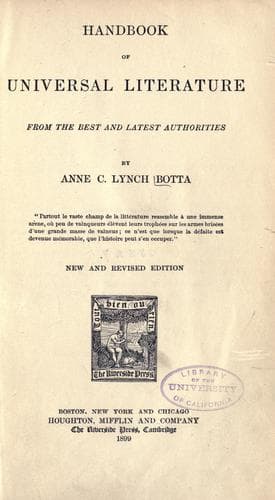
Handbook of Universal Literature, From the Best and Latest AuthoritiesBotta, Anne C. Lynch (Anne Charlotte Lynch)
History
Handbook of Universal Literature, From the Best and Latest Authorities
Botta, Anne C. Lynch (Anne Charlotte Lynch)
Literature -- History and criticism
Bentivoglio (1506-1573), Salviati (1540-1589), Firenzuola (1493-1547),
Caro (1507-1566), Cardinal Bibiena, (1470-1520), Aretino (1492-1556), and
others, are among the principal comic writers of the age, who displayed
more or less dramatic talent. Of all the Italian comedies composed in the
sixteenth century, however, scarcely one was the work of eminent genius. A
species of comic drama, known under the name of _Commedia dell' arte_,
took its rise in this century. The characteristic of these plays is that
the story only belongs to the poet, the dialogue being improvised by the
actors. The four principal characters, denominated masks, were
_Pantaloon_, a merchant of Venice, a doctor of laws from Bologna, and two
servants, known to us as _Harlequin_ and _Columbine_. When we add to these
a couple of sons, one virtuous and the other profligate; a couple of
daughters, and a pert, intriguing chambermaid, we have nearly the whole
_dramatis personae_ of these plays. The extempore dialogue by which the
plot was developed was replete with drollery and wit, and there was no end
to the novelty of the jests.
7. PASTORAL DRAMA AND DIDACTIC POETRY.--The pastoral drama, which
describes characters and passions in their primitive simplicity, is thus
distinguished from tragedy and comedy. It is probable that the idyls of
the Greeks afforded the first germ of this species of composition, but
Beccari, a poet of Ferrara (1510-1590), is considered the father of the
genuine pastoral drama. Before him Sannazzaro (1458-1530) had written the
"Arcadia," which, however, bears the character of an eclogue rather than
that of a drama. It is written in the choicest Italian; its versification
is melodious, and it abounds with beautiful descriptions; as an imitation
of the ancients, it is entitled to the highest rank. The beauty of the
Italian landscape and the softness of the Italian climate seem naturally
fitted to dispose the poetic soul to the dreams of rural life, and the
language seems, by its graceful simplicity, peculiarly adapted to express
the feelings of a class of people whom we picture to ourselves as
ingenuous and infantine in their natures. The manners of the Italian
peasantry are more truly pastoral than those of any other people, and a
bucolic poet in that fair region need not wander to Arcadia. But
Sannazzaro, like all the early pastoral poets of Italy, proposed to
himself, as the highest excellence, a close imitation of Virgil; he took
his shepherds from the fabulous ages of antiquity, borrowed the mythology
of the Greeks, and completed the machinery with fauns, nymphs, and satyrs.
Like Sannazzaro, Beccari places his shepherds in Arcadia, and invests them
with ancient manners; but he goes beyond mere dialogue; he connects their
conversations by a series of dramatic actions. The representation of one
of these poems incited Tasso to the composition of his "Aminta," the
success of which was due less to the interest of the story than to the
Public-domain text, read in full here on John Shaqi.
Reviews
Reviews
No reviews yet
Be the first to share your thoughts on this work.
Elsewhere in the archive
Join the Discussion
Join the discussion
Sign in to leave a comment or review.
Sign InorCreate an account