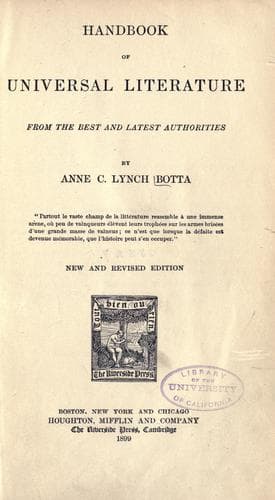
Handbook of Universal Literature, From the Best and Latest AuthoritiesBotta, Anne C. Lynch (Anne Charlotte Lynch)
History
Handbook of Universal Literature, From the Best and Latest Authorities
Botta, Anne C. Lynch (Anne Charlotte Lynch)
Literature -- History and criticism
sweetness of the poetry, and the soft voluptuousness which breathes in
every line. It is written in flowing verse of various measures, without
rhyme, and enriched with lyric choruses of uncommon beauty.
The imitations of the Aminta were numerous, but, with one exception, which
has disputed the palm with its model, they had an ephemeral existence.
Guarini (1537-1612) was the author of the "Pastor Fido," which is the
principal monument of his genius; its chief merit lies in the poetry in
which the tale is embodied, the simplicity and clearness of the diction,
the tenderness of the sentiments, and the vehement passion which gives
life to the whole. This drama was first performed in 1585, at Turin,
during the nuptial festivities of the Prince of Savoy. Its success was
triumphant, and Guarini was justly considered as second only to Tasso
among the poets of the age. Theatrical music, which was now beginning to
be cultivated, found its way into the acts of the pastoral drama, and in
one scene of the Pastor Fido it is united with dancing; thus was opened
the way for the Italian opera.
Among the didactic poets, Rucellai may be first mentioned. His poem of
"The Bees" is an imitation of the fourth book of the Georgics; he does
not, however, servilely follow his model, but gives an original coloring
to that which he borrowed. Alamanni (1495-1556) occupies a secondary rank
among epic, tragic, and comic poets, but merits a distinguished place in
didactic poetry. His poem entitled "Cultivation" is pure and elegant in
its style.
8. SATIRICAL POETRY, NOVELS, AND TALES.--In an age when every kind of
poetry that had flourished among the Greeks and Romans appeared again with
new lustre, satire was not wanting. There is much that is satirical in the
"Divine Comedy" of Dante. Three of Petrarch's sonnets are satires on the
court of Rome; those of Ariosto are valuable not only for their flowing
style, but for the details they afford of his character, taste, and
circumstances. The satires of Alamanni are chiefly political, and in
general are characterized by purity of diction and by a high moral
tendency.
Public-domain text, read in full here on John Shaqi.
Reviews
Reviews
No reviews yet
Be the first to share your thoughts on this work.
Elsewhere in the archive
Join the Discussion
Join the discussion
Sign in to leave a comment or review.
Sign InorCreate an account