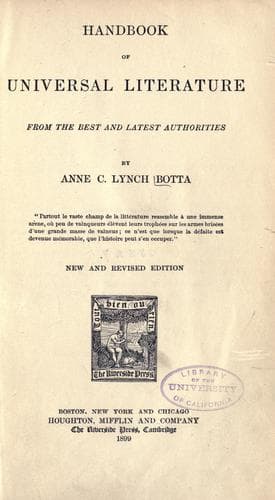
Handbook of Universal Literature, From the Best and Latest AuthoritiesBotta, Anne C. Lynch (Anne Charlotte Lynch)
History
Handbook of Universal Literature, From the Best and Latest Authorities
Botta, Anne C. Lynch (Anne Charlotte Lynch)
Literature -- History and criticism
There is a kind of jocose or burlesque satire peculiar to Italy, in which
the literature is extremely rich. If it serves the cause of wisdom, it is
always in the mask of folly. The poet who carried this kind of writing to
the highest perfection was Berni (1499-1536). Comic poetry, hitherto known
in Italy as burlesque, of which Burchiello was the representative in the
fifteenth century, received from Berni the name of Bernesque, in its more
refined and elegant character. His satirical poems are full of light and
elegant mockery, and his style possesses nature and comic truth. In his
hand, everything was transformed into ridicule; his satire is almost
always personal, and his laughter is not always restrained by respect for
morals or for decency. To burlesque poetry may be referred also the
Macaronic style, a ludicrous mixture of Latin and Italian, introduced by
Merlino Coccajo (1491-1544). His poems are as full of lively descriptions
and piquant satire as they are wanting in decorum and morality.
The story-tellers of the sixteenth century are numerous. Sometimes they
appear as followers of Boccaccio; sometimes they attempt to open new paths
for themselves. The class of productions, of which the "Decameron" was the
earliest example in the fourteenth century, is called by the Italians
"Novelle." In general, the interest of the tale depends rather on a number
of incidents slightly touched, than on a few carefully delineated; from
the difficulty of developing character in a few isolated scenes, the
story-teller trusts for effect to the combination of incident and style,
and the delineation of character, which is the nobler part of fiction, is
neglected. Italian novelists, too, have often regarded the incidents
themselves but as a vehicle for fine writing. An interesting view of these
productions is, that they form a vast repository of incident, in which we
recognize the origin of much that has since appeared in our own and other
languages.
Machiavelli was one of the first novelists of this age. His little tale,
"Belfagor," is pleasantly told, and has been translated into all
languages. The celebrated "Giulietta" of Luigi da Porta is the sole
production of the author, but it has served to give him a high place among
Italian novelists. This is Shakspeare's Romeo and Juliet in another shape,
though it is not probable that it was the immediate source from which the
great dramatist collected the materials for his tragedy. The "Hundred
Tales" of Cinzio Giraldi (1504-1573) are distinguished by great boldness
of conception, and by a wild and tragic horror which commands the
attention, while it is revolting to the feelings. He appears to have
ransacked every age and country, and to have exhausted the catalogue of
human crimes in procuring subjects for his novels.
Public-domain text, read in full here on John Shaqi.
Reviews
Reviews
No reviews yet
Be the first to share your thoughts on this work.
Elsewhere in the archive
Join the Discussion
Join the discussion
Sign in to leave a comment or review.
Sign InorCreate an account