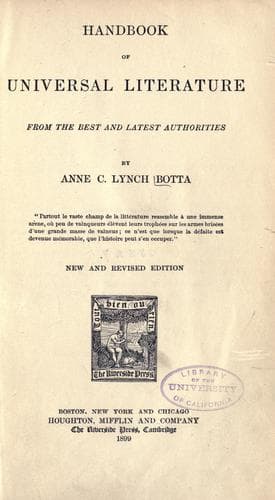
Handbook of Universal Literature, From the Best and Latest AuthoritiesBotta, Anne C. Lynch (Anne Charlotte Lynch)
History
Handbook of Universal Literature, From the Best and Latest Authorities
Botta, Anne C. Lynch (Anne Charlotte Lynch)
Literature -- History and criticism
The oratory of this period is very imperfect. Orations were written in the
style of Boccaccio, which, however suitable for the narration of merry
tales, is entirely unfit for oratorical compositions. Among those who most
distinguished themselves in this department are Della Casa (1503-1556),
whose harangues against the Emperor Charles V. are full of eloquence;
Speroni (1500-1588), whose style is more perfect than that of any other
writer of the sixteenth century; and Lollio (d. 1568), whose orations are
the most polished. At that time, in the forum of Venice, eloquent orators
pleaded the causes of the citizens, and at the close of the preceding
century, Savonarola (1452-1498), a preacher of Florence, thundered against
the abuses of the Roman church, and suffered death in consequence. Among
the models of letter-writing, Caro takes the first place. His familiar
letters are written with that graceful elegance which becomes this kind of
composition. The letters of Tasso are full of eloquence and philosophy,
and are written in the most select Italian.
11. SCIENCE, PHILOSOPHY, AND POLITICS.--The sciences, during this period,
went hand in hand with poetry and history. Libraries and other aids to
learning were multiplied, and academies were organized with other objects
than those of enjoyment of mere poetical triumphs or dramatic amusements.
The Academy del Cimento was founded at Florence in 1657 by Leopold de'
Medici, for promoting the study of the natural sciences, and similar
institutions were established in Rome, Bologna, and Naples, and other
cities of Italy, besides the Royal Academy of London (1660), and the
Academy of Sciences in Paris (1666). From the period of the first
institution of universities, that of Bologna had maintained its
preëminence. Padua, Ferrara, Pavia, Turin, Florence, Siena, Pisa, and Rome
were also seats of learning. The men who directed the scientific studies
of their country and of Europe were almost universally attached as
professors to these institutions. Indeed, at this period, through the
genius of Galileo and his school, European science first dawned in Italy.
Galileo (1564-1641) was a native of Pisa, and professor of mathematics in
the university of that city. Being obliged to leave it on account of
scientific opinions, at that time at variance with universally received
principles, he removed to the university of Padua, where for eighteen
years he enjoyed the high consideration of his countrymen. He returned to
Pisa, and at the age of seventy was summoned to Rome by the Inquisition,
and required to renounce his doctrines relative to the Copernican system,
of which he was a zealous defender, and his life was spared only on
condition of his abjuring his opinions. It is said that on rising from his
knees, after making the abjuration of his belief that the earth moved
round the sun, he stamped his foot on the floor and said, "It does move,
though." To Galileo science is indebted for the discovery of the laws of
Public-domain text, read in full here on John Shaqi.
Reviews
Reviews
No reviews yet
Be the first to share your thoughts on this work.
Elsewhere in the archive
Join the Discussion
Join the discussion
Sign in to leave a comment or review.
Sign InorCreate an account