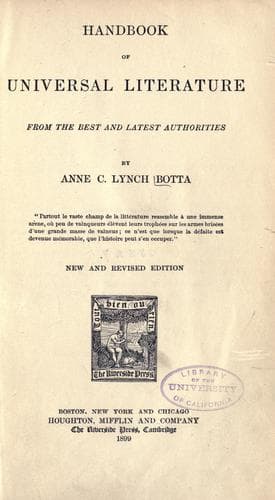
Handbook of Universal Literature, From the Best and Latest AuthoritiesBotta, Anne C. Lynch (Anne Charlotte Lynch)
History
Handbook of Universal Literature, From the Best and Latest Authorities
Botta, Anne C. Lynch (Anne Charlotte Lynch)
Literature -- History and criticism
weight, the scientific construction of the system of Copernicus, the
pendulum, the improvement of many scientific instruments, the invention of
the hydrostatic balance, the thermometer, proportional compasses, and,
above all, the telescope. He discovered the satellites of Jupiter, the
phases of Venus, the mountains of the moon, the spots and the rotation of
the sun. Science, which had consisted for centuries only of scholastic
subtleties and barren dialectics, he established on an experimental basis.
In his works he unites delicacy and purity with vivacity of style.
Among the scholars of Galileo, who most efficaciously contributed to the
progress of science, may be mentioned Torricelli (1608-1647), the inventor
of the barometer, an elegant and profound writer; Borelli (1608-1679), the
founder of animal mechanics, or the science of the movements of animals,
distinguished for his works on astronomy, mathematics, anatomy, and
natural philosophy; Cassini (1625-1712), a celebrated astronomer, to whom
France is indebted for its meridian; Cavalieri (1598-1648), distinguished
for his works on geometry, which paved the way to the discovery of the
infinitesimal calculus.
In the scientific department of the earlier part of this period may also
be mentioned Tartaglia (d. 1657) and Cardano (1501-1576), celebrated for
their researches on algebra and geometry; Vignola (1507-1573) and Palladio
(1518-1580), whose works on architecture are still held in high
estimation, as well as the work of Marchi (fl. 1550) on military
construction. Later, Redi (1626-1697) distinguished himself as a natural
philosopher, a physician and elegant writer, both in prose and verse, and
Malpighi (1628-1694) and Bellini (1643-1704) were anatomists of high
repute. Scamozzi (1550-1616) emulated the glory formerly won by Palladio
in architecture, and Montecuccoli (1608-1681), a great general of the age,
ably illustrated the art of strategy.
The sixteenth century abounds in philosophers who, abandoning the
doctrines of Plato, which had been in great favor in the fifteenth,
adopted those of Aristotle. Some, however, dared to throw off the yoke of
philosophical authority, and to walk in new paths of speculation. Patrizi
(1529-1597) was one of the first who undertook to examine for himself the
phenomena of nature, and to attack the authority of Aristotle. Telesio
(1509-1588), a friend of Patrizi, joined him in the work of overthrowing
the Peripatetic idols; but neither of them dared to renounce entirely the
authority of antiquity. The glory of having claimed absolute freedom in
philosophical speculation belongs to Cardano, already mentioned, to
Campanella (1568-1639), who for the boldness of his opinions was put to
the torture and spent thirty years in prison, and to Giordano Bruno (1550-
1600), a sublime thinker and a bold champion of freedom, who was burned at
the stake.
Public-domain text, read in full here on John Shaqi.
Reviews
Reviews
No reviews yet
Be the first to share your thoughts on this work.
Elsewhere in the archive
Join the Discussion
Join the discussion
Sign in to leave a comment or review.
Sign InorCreate an account