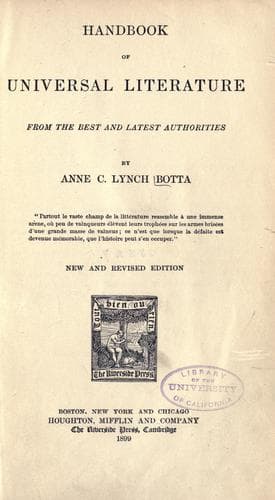
Handbook of Universal Literature, From the Best and Latest AuthoritiesBotta, Anne C. Lynch (Anne Charlotte Lynch)
History
Handbook of Universal Literature, From the Best and Latest Authorities
Botta, Anne C. Lynch (Anne Charlotte Lynch)
Literature -- History and criticism
Among the moral philosophers of this age may be mentioned Speroni, whose
writings are distinguished by harmony, freedom, and eloquence of style;
Tasso, whose dialogues unite loftiness of thought with elegance of style;
Castiglione (1468-1529), whose "Cortigiano" is in equal estimation as a
manual of elegance of manners and as a model of pure Italian; and Della
Casa, whose "Galateo" is a complete system of politeness, couched in
elegant language, and a work to which Lord Chesterfield was much indebted.
Political science had its greatest representative in Machiavelli, who
wrote on it with that profound knowledge of the human heart which he had
acquired in public life, and with the habit of unweaving, in all its
intricacies, the political perfidy which then prevailed in Italy. The
"Prince" is the best known of his political works, and from the infamous
principles which he has here developed, though probably with good
intentions, his name is allied with everything false and perfidious in
politics. The object of the treatise is to show how a new prince may
establish and consolidate his power, and how the Medici might not only
confirm their authority in Florence, but extend it over the whole of the
Peninsula. At the time that Machiavelli wrote, Italy had been for
centuries a theatre where might was the only right. He was not a man given
to illusive fancies, and throughout a long political career nothing had
been permitted to escape his keen and penetrating eye. In all the affairs
in which he had taken part he had seen that success was the only thing
studied, and therefore to succeed in an enterprise, by whatever means, had
become the fundamental idea of his political theory. His Prince reduced to
a science the art, long before known and practiced by kings and tyrants,
of attaining absolute power by deception and cruelty, and of maintaining
it afterwards by the dissimulation of leniency and virtue. It does not
appear that any exception was at first taken to the doctrines which have
since called forth such severe reprehension, and from the moment of its
appearance the Prince became a favorite at every court. But soon after the
death of Machiavelli a violent outcry was raised against him, and although
it was first heard with amazement, it soon became general, The Prince was
laid under the ban of several successive popes, and the name of
Machiavelli passed into a proverb of infamy. His bones lay undistinguished
for nearly two centuries, when a monument was erected to his memory in the
church of Santa Croce, through the influence of an English nobleman.
Public-domain text, read in full here on John Shaqi.
Reviews
Reviews
No reviews yet
Be the first to share your thoughts on this work.
Elsewhere in the archive
Join the Discussion
Join the discussion
Sign in to leave a comment or review.
Sign InorCreate an account