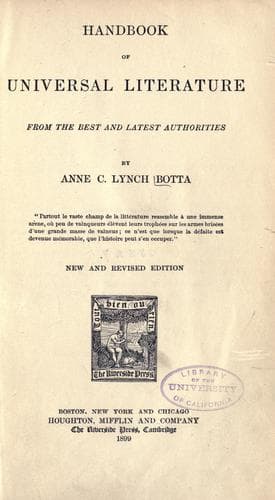
Handbook of Universal Literature, From the Best and Latest AuthoritiesBotta, Anne C. Lynch (Anne Charlotte Lynch)
History
Handbook of Universal Literature, From the Best and Latest Authorities
Botta, Anne C. Lynch (Anne Charlotte Lynch)
Literature -- History and criticism
Metastasio (1698-1782) gave early indications of genius, and when only ten
years of age used to collect an audience in his father's shop, by his
talent for improvisation. He thus attracted the notice of Gravina, a
celebrated patron of letters, who adopted him as his son, changed his
somewhat ignoble name of Trepassi to Metastasio, and had him educated in
every branch necessary for a literary career. He still continued to
improvise verses on any given subject for the amusement of company. His
youth, his harmonious voice, and prepossessing appearance, added greatly
to the charm of his talent. It was one generally cultivated in Italy at
this time, and men of mature years often presented themselves as rivals of
the hoy. This occupation becoming injurious to the youth, Gravina forbade
him to compose extempore verses any more, and this rule, imposed on him at
sixteen, he never afterwards infringed. When Metastasio was in his
twentieth year Gravina died, leaving to him his fortune, most of which he
squandered in two years. He afterwards went to Naples, where, under a
severe master, he devoted himself to the closest study and for two years
resisted every solicitation to compose verses. At length, under promise of
secrecy, he wrote a drama. All Naples resounded with its praise, and the
author was soon discovered. Metastasio from this time followed the career
for which nature seemed to have formed him, and devoted himself to the
opera, which he considered to be the natural drama of Italy. An invitation
to become the court poet of Vienna made his future life both stable and
prosperous. On the death of Charles VI., in 1740, several other European
sovereigns made advantageous overtures to the poet, but as Maria Theresa
was disposed to retain him, he would not leave her in her adverse
circumstances. The remainder of his life he passed in Germany, and his
latter years were as monotonous as they were prosperous.
Metastasio seized with a daring hand the true spirit of the melodrama, and
scorning to confine himself to unity of place, opened a wide field for the
display of theatrical variety, on which the charm of the opera so much
depends. The language in which he clothed the favorite passion of his
drama exhibits all that is delicate and yet ardent, and he develops the
most elevated sentiments of loyalty, patriotism, and filial love. The flow
of his verse in the recitative is the most pure and harmonious known in
any language, and the strophes at the close of each scene are scarcely
surpassed by the first masters in lyric poetry. Metastasio is one of the
most pleasing, at the same time one of the least difficult of the Italian
poets, and the tyro in the study of Italian classics may begin with his
works, and at once enjoy the pleasures of poetic harmony at their highest
source.
Public-domain text, read in full here on John Shaqi.
Reviews
Reviews
No reviews yet
Be the first to share your thoughts on this work.
Elsewhere in the archive
Join the Discussion
Join the discussion
Sign in to leave a comment or review.
Sign InorCreate an account