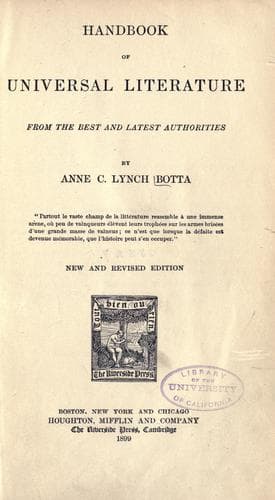
Handbook of Universal Literature, From the Best and Latest AuthoritiesBotta, Anne C. Lynch (Anne Charlotte Lynch)
History
Handbook of Universal Literature, From the Best and Latest Authorities
Botta, Anne C. Lynch (Anne Charlotte Lynch)
Literature -- History and criticism
3. COMEDY.--The revolution, so frequently attempted in Italian comedy by
men whose genius was unequal to the task, was reserved for Goldoni (1707-
1772) to accomplish. His life, written by himself, presents a picture of
Italian manners in their gayest colors. He was a native of Venice, and
from his early youth was constantly surrounded by theatrical people. At
eight years of age he composed a comedy, and at fourteen he ran away from
school with a company of strolling players. He afterwards prepared for the
medical, then for the legal profession, and finally, at the age of twenty-
seven, he was installed poet to a company of players. He now attempted to
introduce the reforms that he had long meditated; he attained a purer
style, and became a censor of the manners and a satirist of the follies of
his country. His dialogue is extremely animated, earnest, and full of
meaning; with a thorough knowledge of national manners, he possessed the
rare faculty of representing them in the most life-like manner on the
stage. The language used by the inferior characters of his comedies is the
Venetian dialect.
In his latter days Goldoni was rivaled by Carlo Gozzi (1722-1806), who
parodied his pieces, and, it is thought, was the cause of his retirement,
in the decline of life, to Paris. Gozzi introduced a new style of comedy,
by reviving the familiar fictions of childhood; he selected and dramatized
the most brilliant fairy tales, such as "Blue Beard," "The King of the
Genii," etc., and gave them to the public with magnificent decorations and
surprising machinery. If his comedies display little resemblance to
nature, they at least preserve the kind of probability which is looked for
in a fairy tale. Many years elapsed after Goldoni and Gozzi disappeared
from the arena before there was any successor to rival their compositions.
Among those who contributed to the perfection of Italian comedy may be
mentioned Albergati (fl. 1774), Gherardo de' Rossi (1754-1827), and above
all, Nota (d. 1847), who is preeminent among the new race of comic
authors; although somewhat cold and didactic, he at least fulfils the
important office of holding the mirror up to nature. He exhibits a
faithful picture of Italian society, and applies the scourge of satire to
its most prevalent faults and follies.
4. TRAGEDY.--The reform of Italian tragedy was early attempted by Martelli
(d. 1727) and by Scipione Maffei (1675-1755). But Martelli was only a tame
imitator of French models, while Maffei, possessing real talent and
feeling, deserved the extended reputation he acquired. His "Merope" is
considered as the last and the best specimen of the elder school of
Italian tragedy.
Public-domain text, read in full here on John Shaqi.
Reviews
Reviews
No reviews yet
Be the first to share your thoughts on this work.
Elsewhere in the archive
Join the Discussion
Join the discussion
Sign in to leave a comment or review.
Sign InorCreate an account