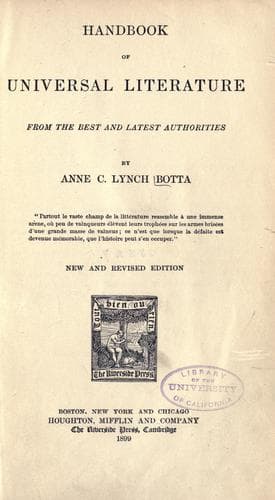
Handbook of Universal Literature, From the Best and Latest AuthoritiesBotta, Anne C. Lynch (Anne Charlotte Lynch)
History
Handbook of Universal Literature, From the Best and Latest Authorities
Botta, Anne C. Lynch (Anne Charlotte Lynch)
Literature -- History and criticism
The honor of raising tragedy to its highest standard was reserved for
Alfieri (1749-1803), whose remarkable personal character exercised a
powerful influence over his works. He was possessed of an impetuosity
which continually urged him towards some indefinite object, a craving for
something more free in politics, more elevated in character, more ardent
in love, and more perfect in friendship; of desires for a better state of
things, which drove him from one extremity of Europe to another, but
without discovering it in the realities of this everyday world. Finally,
he turned to the contemplation of a new universe in his own poetical
creations, and calmed his agitations by the production of those master-
pieces which have secured his immortality. His aim in life, in the pursuit
of which he never deviated, was that of founding a new and classic school
of tragedy. He proposed to himself the severe simplicity of the Greeks
with respect to the plot, while he rejected the pomp of poetry which
compensates for interest among the classic writers of antiquity. Energy
and conciseness are the distinguishing features of his style; and this, in
his earlier dramas, is carried to the extreme. He brings the whole action
into one focus; the passion he would exhibit is introduced into the first
verse and kept in view to the last. No event, no character, no
conversation unconnected with the advancement of the plot is permitted to
appear; all confidants and secondary personages are, therefore, excluded,
and there seldom appear more than four interlocutors. These tragedies
breathe the spirit of patriotism and freedom, and for this, even
independently of their intrinsic merit, Alfieri is considered as the
reviver of the national character in modern times, as Dante was in the
fourteenth century. "Saul" is regarded as his masterpiece; it represents a
noble character suffering under those weaknesses which sometimes accompany
great virtues, and are governed by the fatality, not of destiny, but of
human nature.
Among the earliest and most distinguished of those who followed in the
path of Alfieri was Monti (1754-1828). Though endowed with a sublime
imagination and exquisite taste, his character was weak and vain, and he,
in turn, celebrated every party as it became the successful one. Educated
in the school of Dante, he introduced into Italian poetry those bold and
severe beauties which adorned its infancy. His "Aristodemus" is one of the
most affecting tragedies in Italian literature. The story is founded on
the narrative of Pausanias. It is simple in its construction, and its
interest is confined almost entirely to the principal personage. In the
loftiness of the characters of his tragedies, and the energy of sentiment
and simplicity of action which characterize them, we recognize the school
of Alfieri, while in harmony and elegance of style and poetical language,
Monti is superior.
Public-domain text, read in full here on John Shaqi.
Reviews
Reviews
No reviews yet
Be the first to share your thoughts on this work.
Elsewhere in the archive
Join the Discussion
Join the discussion
Sign in to leave a comment or review.
Sign InorCreate an account