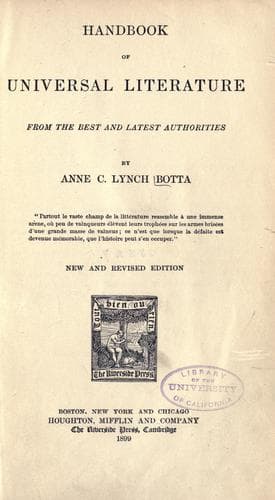
Handbook of Universal Literature, From the Best and Latest AuthoritiesBotta, Anne C. Lynch (Anne Charlotte Lynch)
History
Handbook of Universal Literature, From the Best and Latest Authorities
Botta, Anne C. Lynch (Anne Charlotte Lynch)
Literature -- History and criticism
Another follower of the school of Alfieri is Ugo Foscolo (1778-1827), one
of the greatest writers of this age, in whom inspiration was derived from
a lofty patriotism. At the time of the French revolution he joined the
Italian army, with the object of restoring independence to his country.
Disappointed in this hope, he left Italy for England, where he
distinguished himself by his writings. The best of his tragedies,
"Ricciarda," is founded on events supposed to have occurred in the Middle
Ages. While some of its scenes and situations are forced and unnatural,
some of the acts are wrought with consummate skill and effect, and the
conception of the characters is tragic and original. Foscolo adopts in his
tragedies a concise and pregnant style, and displays great mastery over
his native language. Marenco (d. 1846) is distinguished for the noble and
moral ideas, lofty images, and affections of his tragedies; but he lacks
unity of design and vigor of style. Silvio Pellico (1789-1854) was born in
Piedmont. As a writer he is best known as the author of "My Prisons," a
narrative full of simplicity and resignation, in which he relates his
sufferings during ten years in the fortress of Spielberg. His tragedies
are good specimens of modern art; they abound in fine thoughts and tender
affections, but they lack that liveliness of dialogue and rapidity of
action which give reality to the situations, and that knowledge of the
human heart and unity and grandeur of conception which are the
characteristics of true genius.
Manzoni (1785-1873) and Nicolini (1782-1861) are the last of the modern
representatives of the tragic drama of Italy. The tragedies of Manzoni,
and especially his "Conte di Carmagnola," and "Adelchi," abound in
exquisite beauties. His style is simple and noble, his verse easy and
harmonious, and his object elevated. The merits of these tragedies,
however, belong rather to parts, and while the reading of them is always
interesting, on the stage they fail to awaken the interest of the
audience. After Manzoni, Nicolini was the most popular literary man of
Italy of his time. Lofty ideas, generous passions, splendor and harmony of
poetry, purity of language, variety of characters, and warmth of
patriotism, constitute the merit of his tragedies; while his faults
consist in a style somewhat too exuberant and lyrical, in ideas sometimes
too vague, and characters often too ideal.
Public-domain text, read in full here on John Shaqi.
Reviews
Reviews
No reviews yet
Be the first to share your thoughts on this work.
Elsewhere in the archive
Join the Discussion
Join the discussion
Sign in to leave a comment or review.
Sign InorCreate an account