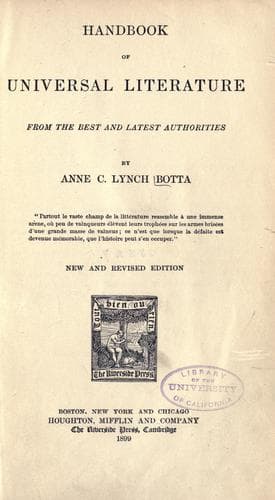
Handbook of Universal Literature, From the Best and Latest AuthoritiesBotta, Anne C. Lynch (Anne Charlotte Lynch)
History
Handbook of Universal Literature, From the Best and Latest Authorities
Botta, Anne C. Lynch (Anne Charlotte Lynch)
Literature -- History and criticism
5. LYRIC, EPIC, AND DIDACTIC POETRY.--In the latter part of the eighteenth
century, a class of poets who called themselves "The Arcadians" attempted
to overthrow the artificial and bombastic school of Marini; but their
frivolous and insipid productions had little effect on the literature. The
first poets who gave a new impulse to letters were Parini and Monti.
Parini (1729-1799) was a man of great genius, integrity, and taste; he
contributed more than any other writer of his age to the progress of
literature and the arts. His lyrical poems abound in noble thoughts, and
breathe a pure patriotism and high morality. His style is forcible,
chaste, and harmonious. The poems of Monti have much of the fire and
elevation of Pindar. Whatever object employs his thoughts, his eyes
immediately behold; and, as it stands before him, a flexible and
harmonious language is ever at his command to paint it in the brightest
colors. His "Basvilliana" is the most celebrated of his lyric poems, and,
beyond every other, is remarkable for majesty, nobleness of expression,
and richness of coloring.
The poetical writings of Pindemonte (1753-1828) are stamped with the
melancholy of his character. Their subjects are taken from contemporary
events, and his inspiration is drawn from nature and rural life. His
"Sepulchres" breathes the sweetest and most pathetic tenderness, and the
brightest hopes of immorality. The poems of Foscolo have the grace and
elegance of the Greek poets; but in his "Sepulchres" the gloom of his
melancholy imagination throws a funereal light over the nothingness of all
things, and the silence of death is unbroken by any voice of hope in a
future life. Torti (1774-1852), a pupil of Parini, rivaled his master in
the simplicity of style and purity of his images; while Leopardi (1798-
1837) impressed upon his lyric poems the peculiarities of his own
character. A sublime poet and a profound scholar, his muse was inspired by
a deep sorrow, and his poems pour out a melancholy that is terrible and
grand, the most agonizing cry in modern literature uttered with a solemn
quietness that elevates and terrifies. The poetry of despair has never had
a more powerful voice than his. He is not only the first poet since Dante,
but perhaps the most perfect prose writer. Berchet (1790-1851) is
considered as the Italian Béranger, and his songs glow with patriotic
fire. Those of Silvio Pellico, always sweet and truthful, bear the stamp
of a calm resignation, hope, and piety. The list of modern lyric poets
closes with Manzoni, whose hymns are models of this style of poetry.
Public-domain text, read in full here on John Shaqi.
Reviews
Reviews
No reviews yet
Be the first to share your thoughts on this work.
Elsewhere in the archive
Join the Discussion
Join the discussion
Sign in to leave a comment or review.
Sign InorCreate an account