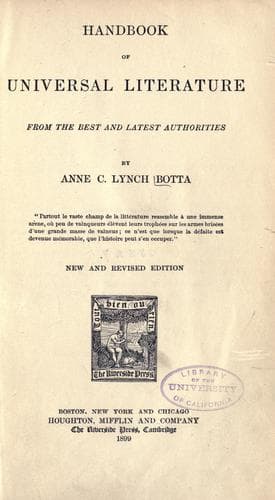
Handbook of Universal Literature, From the Best and Latest AuthoritiesBotta, Anne C. Lynch (Anne Charlotte Lynch)
History
Handbook of Universal Literature, From the Best and Latest Authorities
Botta, Anne C. Lynch (Anne Charlotte Lynch)
Literature -- History and criticism
In the epic department the third period does not afford any poems of a
high order. But the translation of the Iliad by Monti, that of the Odyssey
by Pindemonte, for their purity of language and beauty of style, may be
considered as epic additions to Italian literature. "The Longobards of the
First Crusade," written by Grossi (1791-1853), excels in beauty and
splendor of poetry all the epic poems of this age, though it lacks unity
of design and comprehensiveness of thought.
Among the didactic poems may be mentioned the "Invitation of Lesbia," by
Mascheroni (1750-1800), a distinguished poet as well as a celebrated
mathematician. This poem, which describes the beautiful productions of
nature in the Museum of Pavia, is considered a masterpiece of didactic
poetry. The "Riseide," or cultivation of rice, by Spolverini (1695-1762),
and the "Silkworm," by Betti (1732-1788), are characterized by poetical
beauties. The poem on the "Immortality of the Soul," by Filorentino (1742-
1815), though defective in style, is distinguished by its elevation of
ideas and sentiments. "The Cultivation of Mountains," by Lorenzi (1732-
1822), is rich in beautiful images and thoughts. "The Cultivation of Olive
Trees," by Arici (1782-1836), his "Corals," and other poems, especially in
their descriptions, are graceful and attractive. "The Seasons" of Barbieri
(1774-1852), though bearing marks of imitation from Pope, is written in a
pure and elegant style.
6. HEROIC-COMIC POETRY, SATIRE, AND FABLE.--The period of heroic-comic
poetry closes in the eighteenth century. The "Ricciardetto" of Fortiguerri
(1674-1735) is the last of the poems of chivalry, and with it terminated
the long series of romances founded on the adventures of Charlemagne and
his paladins. The "Cicero" of Passeroni (1713-1803) is a rambling
composition in a style similar to Sterne's "Tristram Shandy," which, it
appears, was suggested by this work.
Satiric poetry, which had flourished in the preceding period, was enriched
by new productions in the eighteenth and nineteenth centuries. G. Gozzi
(1713-1789) attacked in his satires the vices and prejudices of his
fellow-citizens, in a forcible and elegant style; and Parini, the great
satirist of the eighteenth century, founded a school of satire, which
proved most beneficial to the country. His poem, "The Day," is
distinguished by fine irony and by the severity with which he attacks the
effeminate habits of his age. He lashes the affectations and vices of the
Milanese aristocracy with a sarcasm worthy of Juvenal. The satires of
D'Elei, Guadagnali, and others are characterized by wit and beauty of
versification. Those of Leopardi are bitter and contemptuous, while Giusti
(1809-1850), the political satirist of his age, scourged the petty tyrants
of his country with biting severity and pungent wit; the circulation of
his satires throughout Italy, in defiance of its despotic governments,
greatly contributed to the revolution of 1848.
Public-domain text, read in full here on John Shaqi.
Reviews
Reviews
No reviews yet
Be the first to share your thoughts on this work.
Elsewhere in the archive
Join the Discussion
Join the discussion
Sign in to leave a comment or review.
Sign InorCreate an account