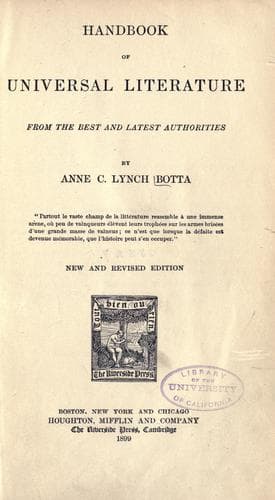
Handbook of Universal Literature, From the Best and Latest AuthoritiesBotta, Anne C. Lynch (Anne Charlotte Lynch)
History
Handbook of Universal Literature, From the Best and Latest Authorities
Botta, Anne C. Lynch (Anne Charlotte Lynch)
Literature -- History and criticism
In the department of fable may be mentioned Roberti (1719-1786),
Passeroni, Pignotti (1739-1812), and Clasio (1754-1825), distinguished for
invention, purity, and simplicity of style.
7. ROMANCES.--Though the tales of Boccaccio and the story tellers of the
sixteenth century paved the way to the romances of the present time, it
was only at a late period that the Italians gave their attention to this
kind of composition. In the eighteenth century we find only two specimens
of romance, "The Congress of Citera," by Algarotti, of which Voltaire said
that it was written with a feather drawn from the wings of love; and the
"Roman Nights," by Alexander Verri (1741-1816). In his romance he
introduces the shades of celebrated Romans, particularly of Cicero, and an
ingenious comparison of ancient and modern institutions is made. The style
is picturesque and poetical, though somewhat florid.
This kind of composition has found more favor in the nineteenth century.
First among the writers of this age is Manzoni, whose "Betrothed" is a
model of romantic literature. The variety, originality, and truthfulness
of the characters, the perfect knowledge of the human heart it displays,
the simplicity and vivacity of its style, form the principal merits of
this work. The "Marco Visconti" of Grossi is distinguished for its pathos
and for the purity and elegance of its style.
The "Ettore Fieramosca" of Massimo d'Azeglio is distinguished from the
works already spoken of by its martial and national spirit. His "Nicolò de
Lapi," though full of beauties, partakes in some degree of the faults
common to the French school. After these, the "Margherita Pusterla" of
Cantil, the "Luisa Strozzi" of Rosini, the "Lamberto Malatesta" of Rovani,
the "Angiola Maria" of Carcano, are the best historical romances of
Italian literature. Both in an artistic and moral point of view, they far
excel those of Guerrazzi, which represent the French school of George Sand
in Italy, and whose "Battle of Benevento," "Isabella Orsini," "Siege of
Florence," and "Beatrice Cenci," while they are written in pure language
and abound in minor beauties, are exaggerated in their characters,
bombastic and declamatory in style, and overloaded in description.
The "Last Letters of Jacopo Ortis," by Foscolo, belongs to that kind of
romance which is called sentimental. Overcome by the calamities of his
country, with his soul full of fiery passion and sad disappointment,
Foscolo wrote this romance, the protest of his heart against evils which
he could not heal.
Public-domain text, read in full here on John Shaqi.
Reviews
Reviews
No reviews yet
Be the first to share your thoughts on this work.
Elsewhere in the archive
Join the Discussion
Join the discussion
Sign in to leave a comment or review.
Sign InorCreate an account