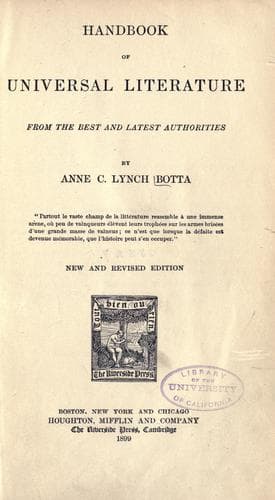
Handbook of Universal Literature, From the Best and Latest AuthoritiesBotta, Anne C. Lynch (Anne Charlotte Lynch)
History
Handbook of Universal Literature, From the Best and Latest Authorities
Botta, Anne C. Lynch (Anne Charlotte Lynch)
Literature -- History and criticism
8. HISTORY.--Among the most prominent of the numerous historians of this
period, a few only can be named. Muratori (1672-1750), for his vast
erudition and profound criticism, has no rivals. He made the most accurate
and extensive researches and discoveries relating to the history of Italy
from the fifth to the sixteenth century, which he published in twenty-
seven folio volumes; the most valuable collection of historical documents
which ever appeared in Italy. He wrote, also, a work on "Italian
Antiquities," illustrating the history of the Middle Ages through ancient
monuments, and the "Annals of Italy," a history of the country from the
beginning of the Christian era to his own age. Though its style is
somewhat defective, the richness and abundance of its erudition, its
clearness, and arrangement, impart to this work great value and interest.
Maffei, already spoken of as the first reformer of Italian tragedy,
surpassed Muratori in the purity of his style, and was only second to him
in the extent and variety of his erudition. He wrote several works on the
antiquities and monuments of Italy.
Bianchini (1662-1729), a celebrated architect and scholar, wrote a
"Universal History," which, though not complete, is characterized as a
work of great genius. It is founded exclusively on the interpretations of
ancient monuments in marble and metal.
Vico (1670-1744), the founder of the philosophy of history, embraced with
his comprehensive mind the history of all nations, and from the darkness
of centuries he created the science of humanity, which he called "Scienza
Nuova." Vico does not propose to illustrate any special historical epoch,
but follows the general movement of mankind in the most remote and obscure
times, and establishes the rules which must guide us in interpreting
ancient historians. By gathering from different epochs, remote from each
other, the songs, symbols, monuments, laws, etymologies, and religious and
philosophical doctrines,--in a word, the infinite elements which form the
life of mankind,--he establishes the unity of human history. The "Scienza
Nuova" is one of the great monuments of human genius, and it has inspired
many works on the philosophy of history, especially among the Germans,
such as those of Hegel, Niebuhr, and others.
Giannone (1676-1748) is the author of a "Civil History of the Kingdom of
Naples," a work full of juridical science as well as of historical
interest. Having attacked with much violence the encroachments of the
Church of Rome on the rights of the state, he became the victim of a
persecution which ended in his death in the fortress of Turin. Giannone,
in his history, gave the first example in modern times of that intrepidity
and courage which belong to the true historian.
Public-domain text, read in full here on John Shaqi.
Reviews
Reviews
No reviews yet
Be the first to share your thoughts on this work.
Elsewhere in the archive
Join the Discussion
Join the discussion
Sign in to leave a comment or review.
Sign InorCreate an account