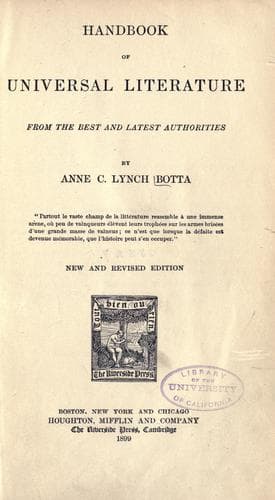
Handbook of Universal Literature, From the Best and Latest AuthoritiesBotta, Anne C. Lynch (Anne Charlotte Lynch)
History
Handbook of Universal Literature, From the Best and Latest Authorities
Botta, Anne C. Lynch (Anne Charlotte Lynch)
Literature -- History and criticism
Botta (1766-1837) is among the first historians of the present age. He was
a physician and a scholar, and devoted to the freedom of his country. He
filled important political offices in Piedmont, under the administration
of the French government. In 1809 he published, in Paris, his "History of
the American Revolution," a work held in high estimation both in this
country and in Italy. In the political changes which followed the fall of
Napoleon, Botta suffered many pecuniary trials, and was even obliged to
sell, by weight, to a druggist, the entire edition of his history, in
order to pay for medicines for his sick wife. Meanwhile, he wrote a
history of Italy, from 1789 to 1814, which was received with great
enthusiasm through Italy, and for which the Academy della Crusca, in 1830,
granted to him a pecuniary reward. This was followed by the "History of
Italy," in continuation of Guicciardini, from the fall of the Florentine
Republic to 1789, a gigantic work, with which he closed his historical
career. The histories of Botta are distinguished by clearness of
narrative, vividness and beauty of description, by the prominence he gives
to the moral aspect of events and characters, and by purity, richness, and
variety of style.
Colletta (1775-1831) was born in Naples; under the government of Murat he
rose to the rank of general, and fell with his patron. His "History of the
Kingdom of Naples," from 1734 to 1825, is modeled after the annals of
Tacitus. The style is simple, clear, and concise, the subject is treated
without digressions or episodes; it is conceived in a partial spirit, and
is a eulogium of the administration of Joachim; but no writer can rival
Colletta in his descriptions of strategic movements, of sieges and
battles.
Balbo (1789-1853) was born in Turin; during the administration of Napoleon
he filled many important political offices, and afterwards entered upon a
military career. Devoted to the freedom of his country, he strove to
promote the progress of Italian independence. In 1847 he published the
"Hopes of Italy," the first political work that had appeared in the
peninsula since the restoration of 1814; it was the spark which kindled
the movements of 1848. In the events of that and of the succeeding year,
he ranked among the most prominent leaders of the national party. His
historical works are a "Life of Dante," considered the best on the
subject; "Historical Contemplations," in which he developed the history of
mankind from a philosophical point of view; and "The Compendium of the
History of Italy," which embraces in a synthetic form all the history of
the country from the earliest times to 1814. His style is pure, clear, and
sometimes eloquent, though often concise and abrupt.
Public-domain text, read in full here on John Shaqi.
Reviews
Reviews
No reviews yet
Be the first to share your thoughts on this work.
Elsewhere in the archive
Join the Discussion
Join the discussion
Sign in to leave a comment or review.
Sign InorCreate an account