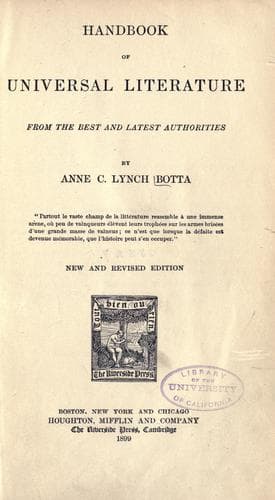
Handbook of Universal Literature, From the Best and Latest AuthoritiesBotta, Anne C. Lynch (Anne Charlotte Lynch)
History
Handbook of Universal Literature, From the Best and Latest Authorities
Botta, Anne C. Lynch (Anne Charlotte Lynch)
Literature -- History and criticism
Cantù, a living historian, has written a universal history, in which he
attempts the philosophical style. Though vivid in his narratives,
descriptions, and details, he is often incorrect in Ms statements, and
rash in his judgments; his work, though professing liberal views, is
essentially conservative in its tendency. The same faults may be
discovered in his more recent "History of the Italians."
Tiraboschi (1731-1794) is the great historian of Italian literature; his
work is biographical and critical, and is the most extensive literary
history of Italy. His style is simple and elegant, and his criticism
profound; but he gives greater prominence to the biographies of writers
than to the consideration of their works. This history was continued by
Corniani (1742-1813), and afterwards by Ugoni (1784-1855).
9. AESTHETICS, CRITICISM, PHILOLOGY, AND PHILOSOPHY.--Italian literature
is comparatively deficient in aesthetics, the science of the beautiful.
The treatise of Gioberti on the "Beautiful," the last work which has
appeared on this subject, is distinguished for its profound doctrines and
brilliant style. Philology and criticism first began to flourish at the
close of the seventeenth century, and are well represented at the present
time. The revival of letters was greatly promoted by the criticism of
Gravina (1664-1718), one of the most celebrated jurisconsults and scholars
of his age, who, through his work, "The Poetical Reason," greatly
contributed to the reform of taste. Zeno, Maffei, and Muratori also
distinguished themselves in the art of criticism, and by their works aided
in overthrowing the school of Marini. At a later date, Gaspar Gozzi,
through his "Observer," a periodical publication modeled after the
"Spectator" of Addison, undertook to correct the literary taste of the
country; for its invention, pungent wit, and satire, and the purity and
correctness of its style, it is considered one of the best compositions of
this kind. Baretti (1716-1789) propagated in England the taste for Italian
literature, and at the same time published his "Literary Scourge," a
criticism of the ancient and modern writers of Italy. His style, though
always pure, is often caustic. He wrote several books in the English
language, one of which is in defense of Shakspeare against Voltaire.
Cesarotti (1730-1808), though eminent as a critic, introduced into the
Italian language some innovations, which contributed to its corruption;
while the nice judgment, good taste, and pure style of Parini place him at
the head of this department. In the latter part of this period we find, in
the criticisms of Monti, vigorous logic and a splendid and attractive
style. Foscolo is distinguished for his acumen and pungent wit. The works
of Perticari (1779-1822) are written with extreme polish, erudition,
judgment, and dignity. In Leopardi, philosophical acumen equals the
elegance of his style. Giordani (d. 1848), as a critic and an epigraphist,
Public-domain text, read in full here on John Shaqi.
Reviews
Reviews
No reviews yet
Be the first to share your thoughts on this work.
Elsewhere in the archive
Join the Discussion
Join the discussion
Sign in to leave a comment or review.
Sign InorCreate an account