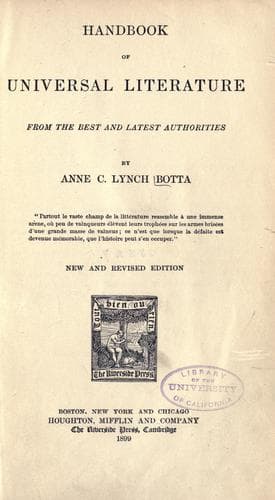
Handbook of Universal Literature, From the Best and Latest AuthoritiesBotta, Anne C. Lynch (Anne Charlotte Lynch)
History
Handbook of Universal Literature, From the Best and Latest Authorities
Botta, Anne C. Lynch (Anne Charlotte Lynch)
Literature -- History and criticism
deserves notice for his fine judgment and pure taste, as do Tommaseo and
Cattaneo, who are both epigrammatic, witty, and pungent.
The golden age of philology dates from the time of Lorenzo de' Medici to
the seventeenth century. It then declined until the eighteenth, but
revived in the works of Maffei, Muratori, Zeno, and others. In the same
century this study was greatly promoted by Foscolo, Monti, and Cesari
(1760-1828), who, among other philological works, published a new edition
of the Dictionary della Crusca, revised and augmented. Of the modern
writers on philology, Gherardini, Tommaseo, and Ascoli are the most
prominent.
The revival of philosophy in Italy dates from the age of Galileo, when the
authority of the Peripatetics was overthrown, and a new method introduced
into scientific researches. From that time to the present, this science
has been represented by opposite schools, the one characterized by
sensualism and the other by rationalism. The experimental method of
Galileo paved the way to the first, which holds that experience is the
only source of knowledge, a doctrine which gained ground in the
seventeenth century, became universally accepted in the eighteenth,
through the influence of Locke and Condillac, and continued to prevail
during the first part of the nineteenth. Gioja (1767-1829), and Romagnosi
(1761-1835) are the greatest representatives of this system, in the last
part of this period. But while the former developed sensualism in
philosophy and economy, the latter applied it to political science and
jurisprudence. The numerous Works of Gioja are distinguished for their
practical value and clearness of style, though they lack eloquence and
purity; those of Romagnosi are more abstract, and couched in obscure arid
often incorrect language, but they are monuments of vast erudition, acute
and profound judgment, and powerful dialectics.
Galluppi (1773-1846), though unable to extricate himself entirely from the
sensualistic school, attempted the reform of philosophy, which resulted in
a movement in Italy similar to that produced by Reid and Dugald Stewart in
Scotland.
Public-domain text, read in full here on John Shaqi.
Reviews
Reviews
No reviews yet
Be the first to share your thoughts on this work.
Elsewhere in the archive
Join the Discussion
Join the discussion
Sign in to leave a comment or review.
Sign InorCreate an account