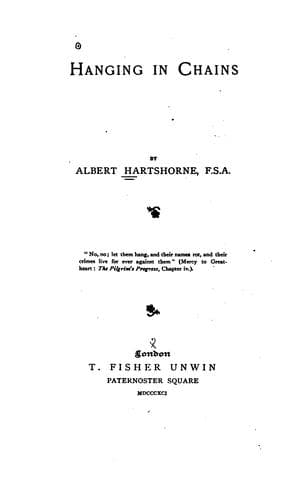
This was written between 1660 and 1670. It is to be observed that the
expression is “irons,” and not _chains_, and that the fact is mentioned
in a simple, natural way, as if the mode of punishment was quite usual
for grave offences. Christiana says--“They should never be bewailed
by me; they have but what they deserve: and I think it well that they
stand so near the highway, that others may see and take warning.” And
she suggests that their crimes should be engraved on an iron or brass
plate, and left “for a caution to other bad men,” which Greatheart told
her had already been done. But Mercy, with a lack of tenderness which
her name and fine earnest character do not bespeak, cries out, “No,
no, let them hang, and their names rot, and their crimes live for ever
against them!”
The crimes in question were combination against the truth, and
opposition unto holiness, figuratively deserving the highest punishment
that could be awarded.
In that strange, shameful, and scarce book, “Le Moyen de Parvenir,”
by Beroalde de Verville, it is recorded that when Charles V. made his
entry into Douai, the inhabitants set up triumphal arches and like
embellishments. At the last moment they bethought themselves of a
wretch who was gibbeted hard by the gate of the principal entrance.
Him they therefore dressed in a clean white shirt, to do honour to the
emperor.[43] It will be noticed that they did not take the body away,
which would have been easier; that would have been illegal.
Before proceeding further it must be stated, as it were to clear the
ground, that there were certain treasonable offences for which women
might be convicted, and it is to the credit of the English law that
the solemn and terrible sentence was not carried out upon them in
its fulness, so that, both for high treason and petit treason, the
sentence ordered merely drawing to the gallows and burning alive. This
sentence was modified in 30 George III. (1791) to drawing, hanging, and
dissecting. It is similarly to the credit of humanity that the bodies
of women were not publicly exposed on gibbets in irons and chains.
In France the same feelings of respect and propriety prevented the
hanging of women at the “fourches patibulaires.” The sentence for grave
offences was that of “la fosse,” or burying alive, usually in front of
the gibbet.
It will be convenient now to give a variety of examples further
illustrating the subject specially under our notice.
We learn from the parish registers of Bourne, in Cambridgeshire,
that Richard Foster, his wife, and his child, were buried on Shrove
Wednesday, 1671. All three were murdered on the preceding Sunday by a
miscreant named George Atkins. He evaded the law for seven years, but
was finally captured, hung, and gibbeted on Caxton Common, adjoining
Bourne.
Public-domain text, read in full here on John Shaqi.
Reviews
Reviews
No reviews yet
Be the first to share your thoughts on this work.
Join the Discussion
Join the discussion
Sign in to leave a comment or review.
Sign InorCreate an account