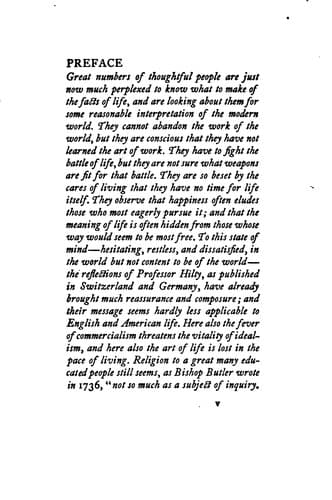
Happiness: Essays on the meaning of lifeHilty, Karl
Philosophy
Happiness: Essays on the meaning of life
Hilty, Karl
Conduct of life; Happiness
In short, if one permit himself habitually to stop and ask that
indolent part of him which the Apostle Paul calls “the old man” what
he would like to do, or would prefer not to do, “the old man” is most
unlikely to vote for serious work, but betakes himself to excellent
religious or moral advice. The bad part of one must be forced to the
habit of obeying, without grumbling, the “categorical imperative”
of the better part. When one has achieved this amount of soldierly
discipline in himself, then he is on the right path, and until he has
reached this point, he has not found his way. Here he first learns
whether his life is saved or lost. Sometimes a man proposes to himself
to collect his thoughts before he begins, or to meditate on the work
he is going to do. In most cases, this is merely an excuse for doing
nothing, and it is most obviously such an excuse, when, to encourage
this preliminary reflection, a man lights his cigar. In short, one’s
best ideas come while he is working, and often, indeed, while he is
working on a wholly different topic. A distinguished modern preacher
has remarked with originality, though not with strict accuracy, that
there is not a single case mentioned in the Bible in which an angel
appeared to a man who was not at work.
In close connection with this point should be mentioned the habit of
using fragments of time. Many people have no time because they always
want to have a large amount of uninterrupted time before they set
themselves to work. In such a plan they are doubly deceived. On the
one hand, in many circumstances of life these prolonged periods are
difficult to secure, and, on the other hand, the power of work which
one possesses is not so unlimited that it can continuously utilize
long stretches of time. This is peculiarly true of such intellectual
work as is devoted to productive effort. Of such work it may be said
without exaggeration that the first hour, or even the first half-hour,
is the most fruitful. Dismissing, however, these large intellectual
undertakings, there are to be found in connection with every piece of
work a great number of subordinate tasks of preparation or arrangement
which are of a mechanical nature, and for each of which a quarter of an
hour or so is sufficient. These minor matters, if not disposed of in
small fragments of time which would otherwise be wasted, will absorb
the time and power which should be devoted to one’s important task. It
might, indeed, be reasonably maintained that the use of these fragments
of time, together with the complete dismissal of the thought, “It is
not worth while to begin to-day,” accounts for half of the intellectual
results which one attains.
Public-domain text, read in full here on John Shaqi.
Reviews
Reviews
No reviews yet
Be the first to share your thoughts on this work.
Join the Discussion
Join the discussion
Sign in to leave a comment or review.
Sign InorCreate an account