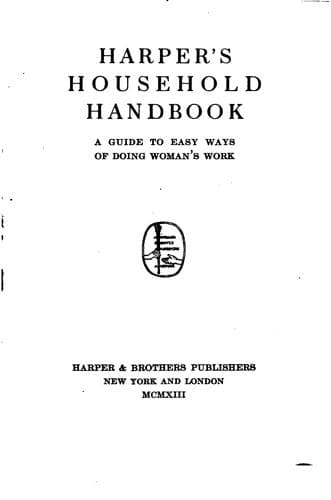
Harper's Household Handbook: A guide to easy ways of doing woman's work — John Shaqi
Harper's Household Handbook: A guide to easy ways of doing woman's workMcCulloch-Williams, Martha
General
Harper's Household Handbook: A guide to easy ways of doing woman's work
McCulloch-Williams, Martha
Formulas, recipes, etc.; Home economics
=Gasolene-cleaning=: Take out spots (see section Spots), then plunge in
a clean vessel, pour on gasolene to cover, wash quickly, laving rather
than rubbing or wringing. Change to clean gasolene, wash again, then
hang to air at least ten hours. This must be done away from fire or
light. Press on the wrong side, and roll around a rod or mailing-tube
instead of folding.
=Washing Silk and Cloth=: Tack, matching pieces together, right sides
in, wash double in warm white soapsuds, rinse twice, keeping temperature
even, and hang to dry without wringing. Take down when damp, and iron
double, going first over one side, then the other. Stiffen by wiping
over ahead of the iron with stale beer, glove liquor, or cold coffee or
weak tea, for silk; with very thin starch or gum water for woolens. Roll
after pressing. Iron cloth the way of the nap, not across it. Figured
silk and brocade should be ironed on a soft board.
=Freshening Lace=: A bath in stale beer with draining afterward freshens
rusty black lace, also stiffens it. It must be pressed when barely damp.
Clean cream and light laces in gasolene, using a very little white soap
if they are much soiled. Hang to air smooth—pressing hurts the look.
Lying in powdered starch and magnesia for a week will often freshen
laces. Mend them before cleaning (see section Making Whole). Shake free
of powder—dust and grime will go with it—and smooth by laying back and
forth between the leaves of a big book and putting on weight.
=Trimmings=: Clean ribbons, braids, galloons, and fringes in a bath of
gasolene, changing at need, hang smooth to air, then press under
weights, else roll inside a damp cloth for an hour, then press on the
wrong side with a warm (not hot) iron. Wind braid about spools or tubes,
and leave a day and night. Comb out fringes and wind around cardboard.
In dyeing fringe fold compactly and sew inside a thin bag, then dye as
usual. The bag prevents the fringe proper from matting.
=As to Turning=: Things worn threadbare had better be turned, either
with or without dyeing. Darn the threadbare spots, loosely and sparsely,
press—on the right side, of course. Press all over, then take stock of
needs and materials. Make the most of every clothes opportunity.
=Freshening Velvet=: Raise the pile of crushed velvet by stretching over
a wet cloth laid on the face of a very hot iron and brushing hard while
the steam rises. This answers for spots and streaks—with a crushed
surface or one so faded dyeing will help it, make into panne velvet by
pressing on the right side while damp, laying the pile all one way.
Velveteen and cotton-backed velvet dye poorly. Brush well, tack on a
board, and paint with hot dye, using a soft brush. Let stand in air to
set, then wash with a cloth and soapsuds, followed by rinsing. Press on
the right side while still damp. This gives a surface passable for
school hats or caps, or yokes and cuffs on made-over frocks.
Public-domain text, read in full here on John Shaqi.
Reviews
Reviews
No reviews yet
Be the first to share your thoughts on this work.
Join the Discussion
Join the discussion
Sign in to leave a comment or review.
Sign InorCreate an account