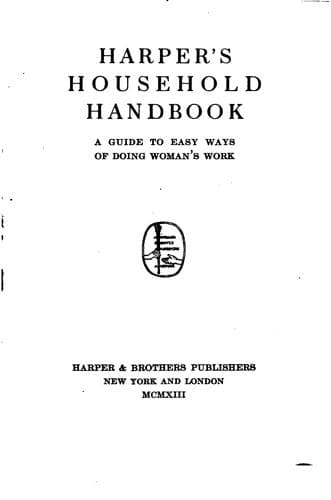
Harper's Household Handbook: A guide to easy ways of doing woman's workMcCulloch-Williams, Martha
General
Harper's Household Handbook: A guide to easy ways of doing woman's work
McCulloch-Williams, Martha
Formulas, recipes, etc.; Home economics
=Save the Pieces=: In cutting down men’s clothes use the worn parts to
interline smaller new garments. Use the very best for the outside, even
though it necessitates piecing. Match threads and figures exactly, sew
fast, and press hard, then piecing hardly shows. Do it before cutting
out. With sleazy stuff whip over edges before sewing together. Avoid
putting pieced seams where there will be constant pressure.
=Adaptation=: A jacket or coat worn along seams may be made to serve
beautifully for a much smaller person by simply ripping all seams,
trimming, and sewing again. Lengthen skirts outgrown by insets of
embroidery or contrasting color. Make the waist to match, either with an
inset or a deep girdle. Aim to make all changes so they shall look
voluntary, not makeshift. In handing down outgrown garments be merciful
enough to change them so the new possessor shall not be taunted for
wearing. This is not hard; a new yoke, belt, and cuffs will transfigure
a garment, to say nothing of the magic wrought by dyeing. Cut, fit, and
finish madeovers quite as carefully as new things. Change trimmings—for
moral and esthetic effect. Make several dyeings—it is piteous to see a
whole family touched up with navy blue or wine-red or pink. Dyes are so
cheap, dyeing so easy, give yourself the satisfaction of variety. If
combining materials, dye them one after the other, the heaviest first.
It is likely to be deepest. Use the lighter tint according to quantity
and taste for foundation or accessories. Remember two good garments, or
even one, will do more good than several skimped and spoiled.
=Millinery=: Steam hats of fancy braid soft, unpick, steam again, sew
while soft, shape, and wire. To change color, paint over with dye, let
dry thoroughly, then wipe over with a cloth wet in alcohol to remove
surplus color. Or wash quickly with white soapsuds, drying in sunlight;
or wipe over with alum water. None of these are necessary if the color
does not rub off. Or veil with net, chiffon, lace, or grenadine. Cord
the brim edge with silk or velvet, and shir the thin stuff inside. Shape
by bending while still damp. Trim according to taste and fashion. Hats
of beaver can be steamed a very little, then pressed over an improvised
block—a fruit jar inverted, a crock, a tin pan, or bucket. Cover with a
damp cloth while pressing. Begin on something of little value, learning
by experience. Hats of velvet or silk or lace must be unpicked,
freshened, and made up anew, using new shapes. Lingerie hats require
simply washing and reshaping over clean frames with fresh or freshened
ribbons.
Public-domain text, read in full here on John Shaqi.
Reviews
Reviews
No reviews yet
Be the first to share your thoughts on this work.
Join the Discussion
Join the discussion
Sign in to leave a comment or review.
Sign InorCreate an account