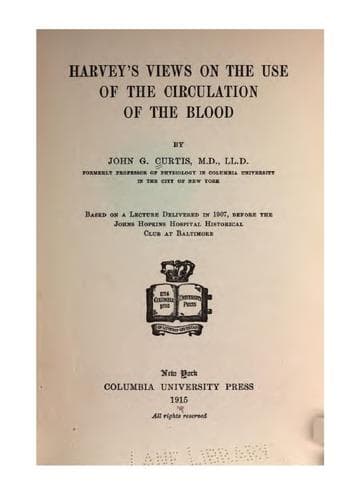
Harvey's Views on the Use of the Circulation of the Blood — John Shaqi
Harvey's Views on the Use of the Circulation of the BloodCurtis, John Green
History
Harvey's Views on the Use of the Circulation of the Blood
Curtis, John Green
Blood -- Circulation; Harvey, William, 1578-1657
"It is more philosophical," he says, "not to share the common
belief that the spirits are distinct and separate from the
humors and parts because the spirits are produced in diverse
places or contained in diverse things," but to hold that the
spirits and the blood are one thing, like the cream and watery
part (serum) in milk or, to borrow a simile from Aristotle's
reasonings about the blood,[64] like heat and water in hot
water, or like flame and a vapor which feeds it (_nidor_). As
light is to a candle, so are the spirits to the blood.[65]
In this passage the discoverer's thought rises high, but in the next
it stoops again. The next passage is headed "Spirits not from air";
and Harvey says in effect, as I understand his difficult words:--
If spirits are made by concoction out of air, the air is made
either thinner or thicker in the process. If made thick, how
does it get from the windpipes into the venous artery? If the
spirits be thinner than air, how are they held[66] by the
tunic of the lung, since this lets pass the pus and serum of
empyema?[65]
In the treatise of 1628 Harvey says that Laurentius
"asserts and proves that, in empyema, serosities and pus
absorbed from the cavity of the chest into the venous artery may
be expelled and got rid of with the urine and fæces through the
left ventricle of the heart and the arteries."[67]
Harvey's argument in his note-book continues thus:--
"How, since mixture consists in the union of altered matters,
can air be thoroughly mixed and made one with blood? What is
that which mixes and alters? If it be heat, the air is made
thinner thereby. If it be urged that the air is thickened by
cold during preparation (which is impossible in the lungs), then
Aristotle's[68] argument holds good: if spirits be from the air,
how about fishes, which are agile and abound in spirits?"[69]
At this point we may call to mind passages in the introduction to
Harvey's treatise of 1628, published more than eleven years after
he had written the notes which we are now studying. In one of
these passages he speaks of what is now called the pulmonary vein,
saying:--
"If it be contended that fumes and air pass to and fro by this
road, as through the bronchia of the lungs, why can we find
neither air nor fumes on dissection, when the venous artery has
been cut out or cut into? And how comes it that we always see
the aforesaid venous artery to be full of thick blood and never
of air, while we perceive that there is air remaining in the
lungs?"[70]
Immediately after the foregoing passage Harvey says that should an
experimenter
Public-domain text, read in full here on John Shaqi.
Reviews
Reviews
No reviews yet
Be the first to share your thoughts on this work.
Join the Discussion
Join the discussion
Sign in to leave a comment or review.
Sign InorCreate an account