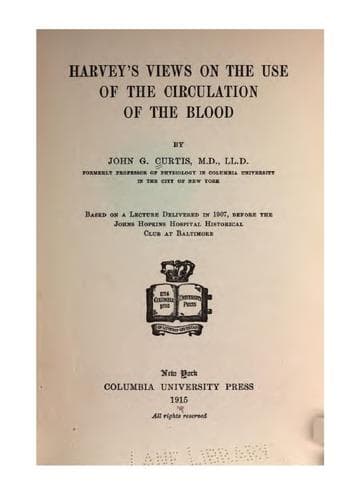
Harvey's Views on the Use of the Circulation of the BloodCurtis, John Green
History
Harvey's Views on the Use of the Circulation of the Blood
Curtis, John Green
Blood -- Circulation; Harvey, William, 1578-1657
"Scaliger, Fernelius, and others lay less weight on the
extraordinary endowments of the blood and imagine other
spirits to exist, aërial or ethereal or composed of substance
both ethereal and elemental, constituting an innate heat more
excellent and more divine, as it were; and these spirits
they believe to be the soul's most immediate instrument, the
fittest for every use. They rely especially upon this argument,
viz.: that the blood, being composed of elements, can exert
no activity beyond the powers of the elements or of bodies
consisting of a mixture thereof. Therefore, they imagine a
spirit, another innate heat, of celestial origin and nature,
to wit: a body most simple, most subtile, most fine, most
mobile, most swift, most clear, ethereal, and sharing in the
quintessence. Nowhere, however, has any such gift of spirit been
demonstrated by them, nor that the same acts beyond the powers
of the elements, or accomplishes greater works than could the
blood alone. As for us who use our senses to guide us in the
scrutiny of things, nowhere have we been able to find anything
of the kind. Furthermore, there exist no cavities destined
for the generation or preservation of these spirits, or even
assigned thereto by the persons aforesaid."[312]
A little farther on we read:--
"I deem it, however, most wonderful that spirits which draw
their origin from heaven and are adorned with such surpassing
endowments should be nourished by our common and elemental air;
especially seeing that their advocates hold that none of the
elements can act beyond its own powers....[313] What need then
is there, say I, of that foreign guest, ethereal heat, since
all can be accomplished by the blood, even as by it; while
from the blood the spirits cannot withdraw a hair's breadth
without perishing? Most assuredly nowhere do they wander or
penetrate as separate bodies without the blood. For whether it
be said that they are generated, nourished, and increased from
the thinner part of the blood, as some believe, or from the
primitive moisture, as others hold; yet it is confessed that
they are never found outside the blood but forever cleave to
the same as to their sustenance, as flame does to oil or to
a wick. Wherefore their tenuity, subtility, mobility, and so
forth, confer no greater advantage than does the blood which
they continually accompany. It follows that the blood suffices
and is fit to be the immediate instrument of the soul, since the
blood is present everywhere and most swiftly permeates hither
and thither."[314]
Public-domain text, read in full here on John Shaqi.
Reviews
Reviews
No reviews yet
Be the first to share your thoughts on this work.
Elsewhere in the archive
Join the Discussion
Join the discussion
Sign in to leave a comment or review.
Sign InorCreate an account