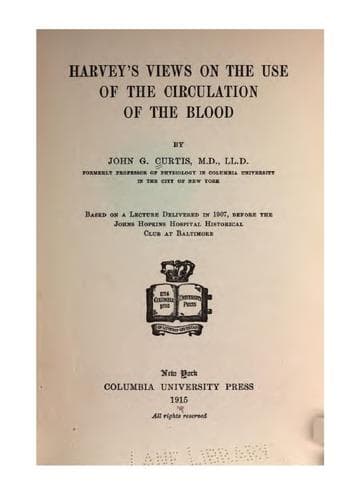
Harvey's Views on the Use of the Circulation of the BloodCurtis, John Green
History
Harvey's Views on the Use of the Circulation of the Blood
Curtis, John Green
Blood -- Circulation; Harvey, William, 1578-1657
The two opponents named by Harvey were not his contemporaries, but
worthies of the Renaissance who had written about one hundred years
before the publication of his treatise On Generation and had died
before he was born. The Italian physician Julius Cæsar Scaliger
had written learned commentaries on Aristotle, as well as other
works; and the Frenchman Jean Fernel, physician to King Henri II of
France, had taught anatomy at Paris and had been a medical writer
of importance. Each of these two authors was nearly sixty years
of age in 1543, in which memorable year were first published the
revolutionary writings of the aged astronomer Copernicus and of
the young anatomist Vesalius, in the second year after the death
of the hardy innovator Paracelsus. Such were the men against whose
doctrines Harvey was impelled in his old age to launch his vigorous
criticism, in order to clear the way for his own doctrine of the
preëminence of the blood. What can we workers of to-day make of
their opinions, which were living for Harvey but now are so deeply
buried? Test-tube and balance, telescope, spectroscope, microscope,
manometer, and the rest, have served their purpose so well since
Harvey's time that even he, one of the foremost worthies of science,
must seem merely to beat the air with words in his last message to
us, unless we can recover his standpoint. Happily he himself shall
attempt to clarify the meaning of his polemic by setting before us
certain words of Aristotle, embodying far-reaching speculations as
to body and soul in relation to the universe. Yet we shall find
these not easy to understand.
Let Harvey continue his criticism of his predecessors. He says:--
"But while they believe that there are found in animals spirits
and ultimate or primitive nourishment, or something else, which
acts beyond the powers of the elements more than does the blood,
they do not seem to have a sufficient grasp of what it may be to
'act beyond the powers of the elements'; nor have they rightly
interpreted the words of Aristotle where he says:[315] 'The
virtue or potency of every soul[316] seems to be associated with
a body[317] other than the so-called elements and more divine.'"
And a little farther on:[318]--
Public-domain text, read in full here on John Shaqi.
Reviews
Reviews
No reviews yet
Be the first to share your thoughts on this work.
Elsewhere in the archive
Join the Discussion
Join the discussion
Sign in to leave a comment or review.
Sign InorCreate an account