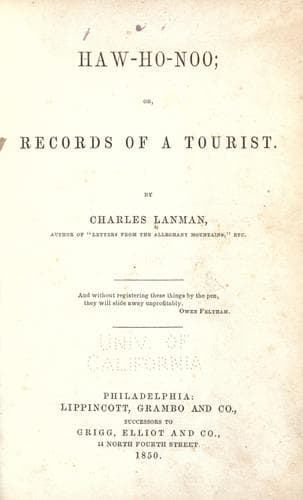
Haw-Ho-Noo; Or, Records of a TouristLanman, Charles
History
Haw-Ho-Noo; Or, Records of a Tourist
Lanman, Charles
Fishing -- North America; United States -- Description and travel
The peninsula of Accomac, as nearly as we can ascertain, varies in width
from eight to twelve miles, and is not far from seventy miles long.
Generally speaking, it is almost as level as the sea, the highest ground
not attaining a greater elevation than some twenty feet. The soil is of
a sandy character, and the forests, which are quite extensive, are
composed chiefly of pine and oak. The country is almost entirely
destitute of running streams, and nearly all the inlets, especially on
the bay side, are lined with extensive marshes, where snakes turtles,
and lizards are particularly abundant. Along the sea side of Accomac lie
a successions of sandy islands, which render the navigation dangerous,
and between which and the main shore the water is shallow and far from
clear. Two of the above islands, Assateague and Chingoteague, are
inhabited by a peculiar people, of whom I shall have something to say in
another place. The only villages in this district, properly so called,
are Drummontown and Eastville; they are the county seats, and though
bearing an ancient appearance, they contain some good houses, and are
well worth visiting. You can hardly travel eight miles in any direction
without coming to a post-office, which glories in a village name, and
therefore appears on paper to much better advantage than in reality. In
some parts of the country, we frequently noticed houses which seemed to
have been abandoned by their owners, as if the soil in the vicinity had
been completely worn out, and could not be profitably cultivated. These
household ruins, together with the apparent want of enterprise which one
notices everywhere, conspire to throw a gloom over the traveler’s mind,
thereby preventing him, perhaps, from fully appreciating the happiness
which really prevails among the people. And these (as is the case, in
fact, with every nook and corner of the world) constitute the principal
attraction of Accomac; for man by nature is a lover of his kind, and “we
have all one human heart by which we live.”
Public-domain text, read in full here on John Shaqi.
Reviews
Reviews
No reviews yet
Be the first to share your thoughts on this work.
Join the Discussion
Join the discussion
Sign in to leave a comment or review.
Sign InorCreate an account