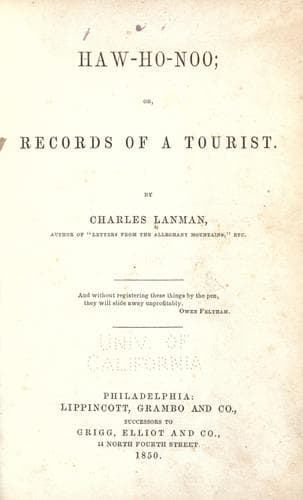
Haw-Ho-Noo; Or, Records of a TouristLanman, Charles
History
Haw-Ho-Noo; Or, Records of a Tourist
Lanman, Charles
Fishing -- North America; United States -- Description and travel
Before proceeding another step, however, we must insert a paragraph
about the various methods employed to capture the salmon. The Indians,
and many white barbarians, spear them by torch-light; and the thousands
sent to market in a smoked condition are taken in nets and seines of
various kinds. But the only instruments used by the scientific angler
are a rod and reel, three hundred feet of hair or silk line, and an
assortment of artificial flies. Our books tell us that a gaudy fly is
commonly the best killer, but our own experience inclines us to the
belief that a large brown or black hackle, or any neatly-made gray fly,
is much preferable to the finest fancy specimens. As to bait-fishing for
salmon, we have never tried it—we care less about it than we know, and
we know but precious little. Next to a delicately made fly, the most
important thing to consider is the leader of the line, which should be
made of the best material (a twisted gut), and at least five feet in
length. But if the angler is afraid of wading in a cold and even a deep
stream, the very best of tackle will avail him nothing. It is but seldom
that a large salmon can be taken, without costing the captor a good deal
of hard labor, and a number of duckings. And when the character of the
fish is remembered, this assertion will not appear strange. Not only is
the salmon a large fish, but he is remarkable for his strength and
lightning quickness. Owing to his extreme carefulness in meddling with
matters that may injure him, it is necessary to use the most delicate
tackle, in the most cautious and expert manner. To pull a salmon in
shore, immediately after he has been hooked, will never do; the expert
way is to give him all the line he wants, never forgetting in the mean
time that it must be kept perfectly taut. And this must be done
continually, in spite of every obstacle, not only when the fish performs
his splendid leaps out of the water, but also when he is stemming the
current of the stream, trying to break the naughty hook against a rock,
or when he has made a sudden wheel, and is gliding down the stream with
the swiftness of a falling star. The last effort to get away, which I
have mentioned, is usually the last that the salmon makes, and it is
therefore of the highest importance that the angler should manage him
correctly when going down. Narrow rifts, and even waterfalls, do not
stop the salmon; and bushes, deep holes, slippery bottoms, and rocky
shores must not impede the course of the angler who would secure a
prize. And though the salmon is a powerful fish, he is not long-winded,
and by his great impatience is apt to drown himself much sooner than one
would suppose. The times most favorable for taking this fish are early
in the morning and late in the afternoon; and when the angler reaches
his fishing ground, and discovers the salmon leaping out of the water,
as if too happy to remain quiet, he may then calculate upon rare sport.
Public-domain text, read in full here on John Shaqi.
Reviews
Reviews
No reviews yet
Be the first to share your thoughts on this work.
Join the Discussion
Join the discussion
Sign in to leave a comment or review.
Sign InorCreate an account