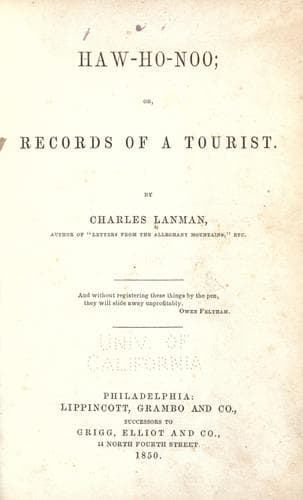
Haw-Ho-Noo; Or, Records of a TouristLanman, Charles
History
Haw-Ho-Noo; Or, Records of a Tourist
Lanman, Charles
Fishing -- North America; United States -- Description and travel
Maple sugar is made from the sap of a tree, known by the several names
of rock maple, hard maple, and sugar maple, which is found in great
abundance in various portions of the Union, but chiefly in the northern
States. It is a lofty and elegantly proportioned tree, and its foliage
is particularly luxuriant; and, when touched by the frosts of autumn, is
pre-eminently brilliant. The wood is also highly esteemed for the beauty
of its fibre, which consists of concentrical circles, resembling the eye
of a bird; and hence the term _birds_-eye maple.
Generally speaking, the sugar-making season commences early in April, is
universally considered as one of festivity, and seldom continues more
than about four weeks. The sudden transition of the temperature from
winter to spring is essential to its production, for at this season
alone does the vital principle of the tree pass in large quantities from
the roots into its branches. Hence it is that, while making this
passage, the sap has to be withdrawn; and this is accomplished by making
an incision in the tree some three feet from the ground, and receiving
the liquid in a vessel prepared for the purpose. And it has been
observed that, when a frosty night is followed by a dry and sunny day,
the sap flows abundantly, at which times three or four gallons are
obtained from a single tree in twenty-four hours. The process employed
for converting the sap into sugar is perfectly simple, and consists in
boiling it first into a sirup and then into a more tangible substance.
Of this sugar there are two kinds, viz., the hard or cake sugar, and
that of a friable character, which is produced by constantly stirring
the thick sirup when it is becoming cool. The taste of the sap or juice,
when taken from the tree, is just sweet enough to be noticed; and though
we have never ascertained the quantity commonly obtained from a single
tree, we have been told that a very fruitful tree, in a good season, may
be made to yield five pounds of the best sugar. To the human palate this
juice is not generally agreeable, but wild and domestic animals are said
to be inordinately fond of it, and slake their thirst with it whenever
they can. Although a sufficient quantity of maple sugar has never been
manufactured in this country to rank it among our articles of
exportation, it has, for many years past, been about the only sugar used
by a large number of people—especially those who live in the more
thickly-wooded districts of the States, and those inhabiting the
northern and western frontiers of the United States and Canada. In the
opinion of all who manufacture the article it is held in high
estimation, both as a luxury and on account of its nutrition. In regard
to this last quality, we believe it is superior to all other sugars; for
we know, from personal observations, that when eaten by the Indian
children, during the manufacturing season, they become particularly
hearty, though exclusively confined to it as an article of food for
Public-domain text, read in full here on John Shaqi.
Reviews
Reviews
No reviews yet
Be the first to share your thoughts on this work.
Join the Discussion
Join the discussion
Sign in to leave a comment or review.
Sign InorCreate an account