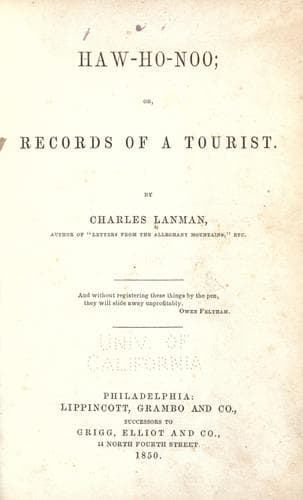
Haw-Ho-Noo; Or, Records of a TouristLanman, Charles
History
Haw-Ho-Noo; Or, Records of a Tourist
Lanman, Charles
Fishing -- North America; United States -- Description and travel
weeks at a time.
From the very nature of the business, the making of maple sugar is
commonly carried on in an encampment, and we now purpose to describe the
various kinds with which we are acquainted, beginning, as a matter of
course, with an Indian camp. We are speaking of the remote past, and of
an encampment of Ottawa Indians, in one of the maple forests skirting
the western shore of Green Bay. It is in the month of April, and the
hunting season is at an end. Albeit, the ground is covered with snow,
the noonday sun has become quite powerful, and the annual offering has
been made to the Great Spirit, by the medicine men, of the first product
of one of the earliest trees in the district. This being the preparatory
signal for extensive business, the women of the encampment proceed to
make a large number of wooden troughs (to receive the liquid treasure),
and, after these are finished, the various trees in the neighborhood are
tapped, and the juice begins to run. In the mean time, the men of the
party have built the necessary fires, and suspended over them their
earthen, brass, or iron kettles. The sap is now flowing in copious
streams, and from one end of the camp to the other is at once presented
an animated and romantic scene, which continues, without interruption,
day and night until the end of the sugar season. The principal
employment to which the men devote themselves is that of lounging about
the encampment, shooting at marks, and playing the moccasin game; while
the main part of the labor is performed by the women, who not only
attend to the kettles, but employ all their leisure time in making the
beautiful birchen mocucks, for the preservation and transportation of
the sugar when made; the sap being brought from the troughs to the
kettles by the boys and girls. Less attention than usual is paid by the
Indians at such times to their meals, and, unless game is very easily
obtained, they are quite content to depend upon the sugar alone. If an
Indian happens to return from the river with a fish, he throws it
without any ceremony into the boiling sap, dipping it out, when cooked,
with a ladle or stick; and therefore it is that we often find in the
maple sugar of Indian manufacture the bones of a trout, or some more
unworthy fish. That even a bird, a rabbit, or an opossum, is sometimes
thrown into the kettle instead of a fish is beyond a doubt; and we are
not positively certain that the civilized fashion of eating jelly with
roast lamb may not be traced to the barbarous custom of cooking animals
in hot sap. That this sap itself, when known to be clear and reduced to
the consistency of molasses, is a palatable article, we are ready to
maintain against the world; and we confess that, when not quite so
fastidious as now, we have often eaten it in truly dangerous quantities,
even in the cabin of an Indian. As we have already intimated, the sugar
season is dependent upon the weather; but, even when it is prolonged to
Public-domain text, read in full here on John Shaqi.
Reviews
Reviews
No reviews yet
Be the first to share your thoughts on this work.
Join the Discussion
Join the discussion
Sign in to leave a comment or review.
Sign InorCreate an account