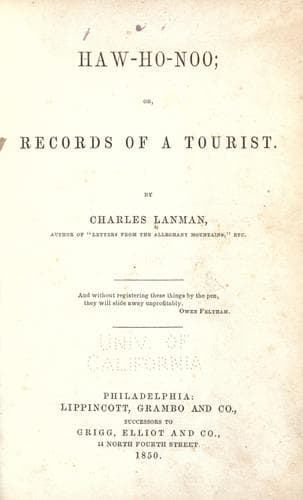
Haw-Ho-Noo; Or, Records of a TouristLanman, Charles
History
Haw-Ho-Noo; Or, Records of a Tourist
Lanman, Charles
Fishing -- North America; United States -- Description and travel
We would now conduct our readers into the sugar camp of a Frenchman. It
is situated in one of the maple forests of Michigan, on the banks of the
river Raisin, and within half a mile of the rude comfortable dwelling of
the proprietor. Very much the same process is here pursued in making the
sugar that we have already described, only that a large proportion of
the labor is performed by the men and boys, the women participating in
the employment more for the purpose of carefully packing away the sugar
when made, and having a little romantic sport in the way of eating hot
sugar in the aisles of the church-like forest. The season of winter with
our Frenchman has been devoted almost exclusively to the pleasures of
life, and the making of sugar is the first and probably the only really
lucrative business which he ever transacts. By the term lucrative we
mean a business which allows him to lay aside a little spare money, for,
generally speaking (like the class to which he belongs in the
north-west), he is perfectly satisfied if the agricultural products of
his small farm yield him a comfortable living. Maple sugar and maple
molasses are considered by our friend and his family as among their
greatest luxuries; and, while he makes a point of taking a goodly
quantity to market, he never fails to keep a plentiful supply of both
under his own roof. In transporting his sugar (as well as all other
marketable articles) to the neighboring town, he employs a rude
two-wheeled vehicle, made exclusively of wood, and drawn by a Canadian
pony. On his first visit to the town after the sugar season is ended, he
will be accompanied by his entire family, decked in their more tidy
garments; and, before his return home, you may be certain that the
Catholic priest, whose church he regularly attends, will receive a
handsome present of the newly-made sugar, with perhaps a small keg of
the delicious maple sirup or molasses. And thus does the Frenchman of
the frontier welcome the return of spring.
But we have spent some pleasant days in the sugar camps of the Dutch
yeomanry on the eastern and southern side of the Catskill Mountains, and
we must not omit to pay our respects to them. The very best of sugar is
made in this region, and much of it into solid cakes of various sizes,
from one pound to twenty. It is manufactured here both for home
consumption and the market, and the price which it has usually commanded
during the last ten years has been about one York shilling per pound.
The labor in this region is about equally divided between the women and
the men, and considerable attention is devoted to the cultivation of the
maple-tree. In cooling their sugar, or rather in performing the business
called “sugaring off,” the Dutch employ immense wrought-iron pans, which
are undoubtedly a great improvement upon the Indian and French fashions,
which are simply no fashions at all, since the kettle employed to boil
the sugar are used to cool it off.
Public-domain text, read in full here on John Shaqi.
Reviews
Reviews
No reviews yet
Be the first to share your thoughts on this work.
Join the Discussion
Join the discussion
Sign in to leave a comment or review.
Sign InorCreate an account