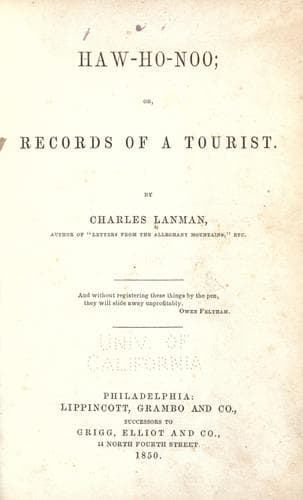
Haw-Ho-Noo; Or, Records of a TouristLanman, Charles
History
Haw-Ho-Noo; Or, Records of a Tourist
Lanman, Charles
Fishing -- North America; United States -- Description and travel
four or five weeks, it continues from beginning to end to be one of
hilarity and gladness. At such times, even the wolfish-looking dogs seem
to consider themselves as entitled to the privilege of sticking their
noses into the vessels of sap not yet placed over the fire. And in this
manner does the poor Indian welcome returning spring.
It is now about the middle of June, and some fifty birchen canoes have
just been launched upon the waters of Green Bay. They are occupied by
our Ottawa sugar-makers, who have started upon a pilgrimage to Mackinaw.
The distance is near two hundred miles, and as the canoes are heavily
laden, not only with mocucks of sugar, but with furs collected by the
hunters during the past winter, and the Indians are traveling at their
leisure, the party will probably reach their desired haven in the course
of ten days. Well content with their accumulated treasures, both the
women and the men are in a particularly happy mood, and many a wild song
is heard to echo over the placid lake. As the evening approaches, day
after day they seek out some convenient landing-place, and, pitching the
wigwams on the beach, spend a goodly portion of the night carousing and
telling stories around their camp fires, resuming their voyage after a
morning sleep, long after the sun has risen above the blue waters of the
east. Another sunset hour, and the cavalcade of canoes is quietly
gliding into the crescent bay of Mackinaw, and, reaching a beautiful
beach at the foot of a lofty bluff, the Indians again draw up their
canoes, again erect their wigwams. And, as the Indian traders have
assembled on the spot, the more improvident of the party immediately
proceed to exhibit their sugar and furs, which are usually disposed of
for flour and pork, blankets and knives, guns, ammunition, and a great
variety of trinkets, long before the hour of midnight. That the
remainder of this night is devoted to feasting and dancing, and
tumultuous recreation, is a matter of course. But the trader who would
obtain from the Indians their more unique articles of merchandize,
usually visits the encampment on the following morning, when he is
always certain of obtaining from the young women, on the most reasonable
terms, their fancy mocucks of sugar, all worked over with porcupine
quills; and a great variety of beautifully worked moccasins, and fancy
bags, made of the sweet-smelling deer skin. In about a week after their
arrival at Mackinaw, the Ottawa Indians begin to sigh for the freedom of
the wilderness; and, before the trader has left his bed on some pleasant
morning, there is nothing to be seen on the beach at Mackinaw but the
smoking embers of a score or two of watch-fires.
Public-domain text, read in full here on John Shaqi.
Reviews
Reviews
No reviews yet
Be the first to share your thoughts on this work.
Join the Discussion
Join the discussion
Sign in to leave a comment or review.
Sign InorCreate an account