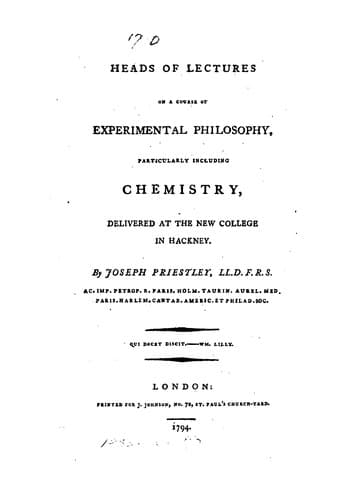
Heads of Lectures on a Course of Experimental Philosophy: Particularly Including ChemistryPriestley, Joseph
Philosophy
Heads of Lectures on a Course of Experimental Philosophy: Particularly Including Chemistry
Priestley, Joseph
Chemistry -- Early works to 1800
The object of experimental philosophy is the knowledge of nature in
general, or more strictly, that of the properties of natural substances,
and of the changes of those properties in different circumstances. This
knowledge can only be attained by _experiment_, or _observation_; as
that clay is capable of becoming hard by means of fire, and thereby
being made into bricks, and that by the same means lime-stone can be
converted into quick-lime, and by the addition of water and sand, make
mortar. It is by observation also that we discover that stones and other
heavy bodies fall to the ground, and that a magnet will attract iron. In
other words, experimental philosophy is an investigation of the wisdom
of God in the works and _the laws of nature_, so that it is one of the
greatest objects to the mind of man, and opens a field of inquiry which
has no bounds; every advance we make suggesting new doubts and subjects
of farther inquiry.
The uniformity we discover in the properties of natural substances
enables us to lay down general rules, or principles, which, being
invariable, we call the laws of nature; and by our knowledge of these
laws we are able to predict, and at our own pleasure to produce,
particular results, and this is the source of all the powers of man. It
is the direction we acquire of the powers of nature; so that, as Lord
Bacon observed, _knowledge is power_.
All arts and manufactures are derived from science. Thus the doctrine of
_mechanics_ is an application of the law of gravitation. Every thing we
are capable of doing by means of the steam-engine is derived from our
knowledge of the properties of water in steam; all the great effects of
gunpowder we owe to our knowledge of the composition, and chemical
properties, of that substance.
Every new appearance in nature is preceded by some new circumstance, and
to this, or rather to something always attending it, we say that the
appearance is _owing_. This circumstance we therefore call the _cause_,
and the new appearance the _effect_ of that cause. Thus we say that the
union of phlogiston to a particular kind of earth is the cause of its
becoming a metal.
It is one of the principal rules of philosophizing to admit no more
causes than are necessary to account for the effects. Thus, if the power
of gravity, by which heavy bodies fall to the earth, be sufficient to
retain the planets in their orbits, we are authorized to reject the
_Cartesian Vortices_. In other words, we must make no more general
propositions than are necessary to comprehend all the particulars
contained in them. Thus, after having observed that iron consists of a
particular kind of earth united to phlogiston, and that it is soluble in
acids; and that the same is true of all other metallic substances, we
say, universally, that all metals consist of a peculiar earth and
phlogiston, and that they are all soluble in some acid.
Public-domain text, read in full here on John Shaqi.
Reviews
Reviews
No reviews yet
Be the first to share your thoughts on this work.
Join the Discussion
Join the discussion
Sign in to leave a comment or review.
Sign InorCreate an account