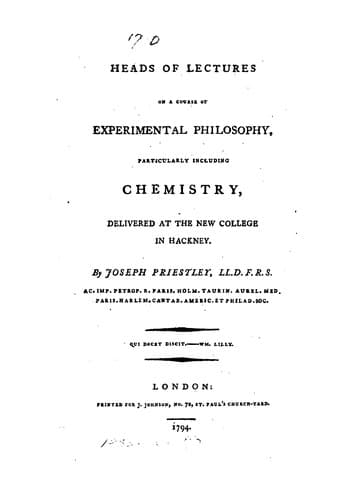
Heads of Lectures on a Course of Experimental Philosophy: Particularly Including ChemistryPriestley, Joseph
Philosophy
Heads of Lectures on a Course of Experimental Philosophy: Particularly Including Chemistry
Priestley, Joseph
Chemistry -- Early works to 1800
Of the circumstances which occasion a change in the properties of
bodies, some are the addition of what are properly called _substances_,
or things that are the objects of our senses, being _visible_,
_tangible_, or having _weight_, &c. Thus the addition of an acid changes
an alkali into a neutral salt. But other changes are occasioned either
by a change of texture in the substance itself, or the addition of
something that is not the object of any of our senses. Thus, a piece of
steel becomes a magnet by the touch of another magnet, and a drop of
glass acquires the property of flying asunder by a small fracture, in
consequence of falling when red hot into cold water. Such also, in the
opinion of some, is the difference between hot and cold substances.
Till the nature of the cause be ascertained, it is convenient to make
use of the term _principle_, as including both of the above-mentioned
causes of the change of properties in bodies. Thus, whatever be the real
cause of gravity, or of inflammability, we may speak of the _principle
of gravity_, or of _inflammability_; whether, with Newton, we suppose
gravity to be occasioned by a fluid pervading the whole universe, which
he termed _aether_, and whether inflammability be caused by the presence
of a real substance called phlogiston, or not. In this manner we use the
letters _x_ and _y_ to denote unknown quantities in algebra.
When changes are made in substances by the addition of other substances,
they make what is called a _chemical union_; and in this case the
properties of the compound cannot with any certainty be deduced from
those of the component parts, but must be ascertained by fresh
experiments. Thus, from the specific gravities, or the degrees of
fusibility, of two metals, those of the compound cannot be predicted.
Neither water nor acid of vitriol will separately dissolve iron, so as
to produce inflammable air, but both together will do it. However, the
properties of similar compounds are similar to one another. Thus, all
metals dissolved in acids are precipitated by mild alkalis. This
chemical union of two substances we ascribe to a certain _elective
attraction_, or _affinity_ that subsists between them, in consequence of
which they unite with one another whenever a proper opportunity offers,
in preference to those substances to which they were before united. Thus
the vitriolic acid, having a stronger affinity with the vegetable alkali
which is the basis of nitre, will unite with that alkali, and with it
form another compound, called _vitriolated tartar_, while the acid of
nitre, being detached from its base, is collected separately.
Public-domain text, read in full here on John Shaqi.
Reviews
Reviews
No reviews yet
Be the first to share your thoughts on this work.
Join the Discussion
Join the discussion
Sign in to leave a comment or review.
Sign InorCreate an account