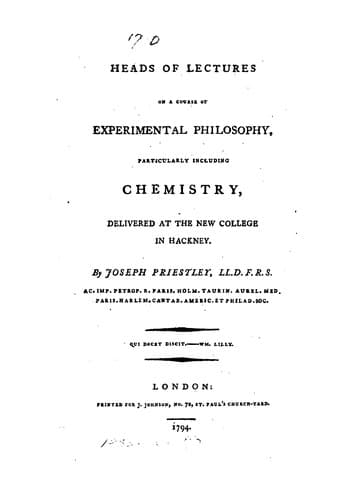
Heads of Lectures on a Course of Experimental Philosophy: Particularly Including ChemistryPriestley, Joseph
Philosophy
Heads of Lectures on a Course of Experimental Philosophy: Particularly Including Chemistry
Priestley, Joseph
Chemistry -- Early works to 1800
Of the different kinds of attraction, that of _gravitation_ seems to
extend to the greatest possible distance; but that which keeps together
the parts of the same substance, thence called the _attraction of
cohesion_, and the different kinds of chemical attractions, called
_affinities_, only act at a small distance. Of the causes of these
attractions we are entirely ignorant.
_Of Aeriform Substances._
Aeriform substances, of which the air that we breathe is one, though
invisible, are real substances, as appears by their excluding other
substances.
That the air has _weight_ appears by actually weighing a vessel before
and after it is exhausted of air by means of an air-pump (an instrument
contrived for that purpose) by its bursting a bladder, and various other
experiments.
Air, being a fluid, presses in all directions, as in the experiment of
the fountain in _vacuo_, and others.
The weight of the air is the cause of the suspension of mercury in a
barometer, and of the action of pumps. The weight of atmospherical air
is to that of water in the proportion of about 1 to 800, so as to press
with the weight of about fourteen pounds on every square inch of
surface.
Air, being an elastic fluid, is capable of occupying more or less space
according to the pressure which it sustains, as appears by a bladder
partially filled with air being expanded when the air is drawn from a
receiver in which it is put, by means of the air-pump, and compressed in
the condensing engine, an instrument the reverse of the air-pump.
Air is necessary to the conveyance of sound, to the existence of flame,
and to animal life.
LECTURE III.
_Of Atmospherical Air._
The first species of air that offers itself to our consideration is that
of the atmosphere, which appears to consist of a mixture of two kinds of
air, of different and opposite qualities, viz., dephlogisticated and
phlogisticated, in the proportion of about one third of the former to
two thirds of the latter. It is by means of the former of these two
ingredients that it is capable of supporting flame and animal life.
This composition of atmospherical air is proved by several substances
absorbing the dephlogisticated air, and leaving the phlogisticated. All
these processes have been termed _phlogistic_, because the effect is not
produced but by substances supposed to contain phlogiston in a volatile
state; and by the affinity between phlogiston and the dephlogisticated
part of the air, the one is separated from the other. Of these processes
are the calcination of metals, a mixture of iron-filings and sulphur,
liver of sulphur, the burning of phosphorus, and the effluvia of
flowers.
In some cases, however, it is not so clear that any thing is emitted
from the substance that produces this effect; for water deprived of all
air will absorb the dephlogisticated part of the atmospherical in
preference to the phlogisticated part.
Public-domain text, read in full here on John Shaqi.
Reviews
Reviews
No reviews yet
Be the first to share your thoughts on this work.
Join the Discussion
Join the discussion
Sign in to leave a comment or review.
Sign InorCreate an account