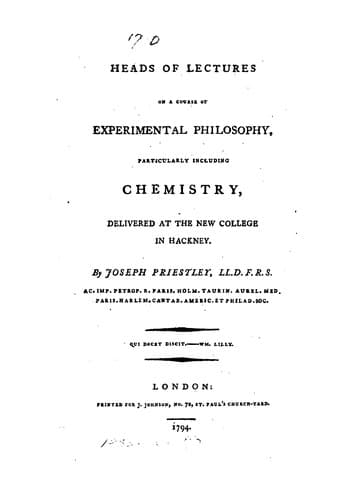
Heads of Lectures on a Course of Experimental Philosophy: Particularly Including Chemistry — John Shaqi
Heads of Lectures on a Course of Experimental Philosophy: Particularly Including ChemistryPriestley, Joseph
Philosophy
Heads of Lectures on a Course of Experimental Philosophy: Particularly Including Chemistry
Priestley, Joseph
Chemistry -- Early works to 1800
Before I consider the properties of particular substances, it will be
proper to mention those which are common to them all. But I shall first
observe, that the term _substance_ has no proper idea annexed to it, but
is merely a convenience in speech; since we cannot speak of the
properties of substances, such as _hard_, _round_, _coloured_, &c. &c.
(which circumstances alone affect our senses, and thereby give proper
ideas) without saying that they inhere in, or belong to, some _thing_,
_substance_, or _substratum_. The terms _being_ and _person_ are also in
the same predicament.
One property of all substances is _extension_, since they all occupy
some portion of space.
The incapacity of any substance to change its place has been termed,
though improperly, the _vis inertiae_ of matter. It is sufficient to say,
that neither this, nor any other effect can be produced without a cause.
_Infinite divisibility_ is a necessary property of all extended
substance; and from this circumstance it will follow, that the smallest
quantity of solid matter may be made to fill the largest space, and yet
none of the pores shall exceed the smallest given magnitude; and
consequently, that, for any thing we know to the contrary, all the
bodies in the universe may be comprized in the smallest space.
Another property usually ascribed to all matter is _impenetrability_,
or the necessary exclusion of any substance from the place occupied by
another. But the only proof of impenetrability is the _resistance_ that
we find to our endeavours to put one substance into the place of
another; and it is demonstrated by experiments, that this resistance is
not occasioned by the actual contact of the substances, but by a power
of repulsion acting at a real distance from their surfaces. It requires
a considerable force to bring two solid substances into as near contact
as the particles of the same substance; and that _these_ are not in
actual contact is evident, from their being capable of being brought
nearer by cold; and this is most remarkable with respect to the
heaviest, that is, the densest, of all substances, viz. the metals.
A more positive argument for the penetrability of matter is, that the
particles of light, after entering the densest transparent substance, do
not appear to meet with any obstruction to their progress till they come
to the opposite side.
The powers of _attraction_ and _repulsion_ seem to be common to all
matter, and the component parts of all substances are kept in their
places by the due balance of those opposite powers. If, by any means,
the particles of any substance be removed beyond their sphere of mutual
attraction, they repel one another, as those of water when it becomes
steam.
Public-domain text, read in full here on John Shaqi.
Reviews
Reviews
No reviews yet
Be the first to share your thoughts on this work.
Join the Discussion
Join the discussion
Sign in to leave a comment or review.
Sign InorCreate an account