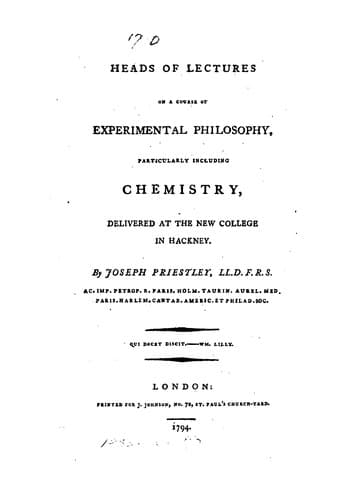
Heads of Lectures on a Course of Experimental Philosophy: Particularly Including Chemistry — John Shaqi
Heads of Lectures on a Course of Experimental Philosophy: Particularly Including ChemistryPriestley, Joseph
Philosophy
Heads of Lectures on a Course of Experimental Philosophy: Particularly Including Chemistry
Priestley, Joseph
Chemistry -- Early works to 1800
It seems to consist of a peculiar acid vapour united to the stony
substance of the fluor; for water being admitted to it absorbs the acid
vapour, and the stony substance is deposited. By this means it exhibits
an amusing appearance, whether water be admitted to a glass jar
previously filled with that air, or the bubbles of air be admitted, as
they are formed, to a quantity of water resting on mercury.
LECTURE X.
_Of Alkaline Air._
Alkaline air is produced by means of heat from caustic volatile alkali,
and also from a mixture of sal-ammoniac and slaked lime, in the
proportion of about one-fourth of the former to three-fourths of the
latter. In this case the marine acid in the sal-ammoniac unites with the
calcareous earth, and the volatile alkali (probably with the assistance
of the water) takes the form of air.
This species of air is heavier than inflammable air, but lighter than
any of the acid airs. Like them, however, it dissolves ice, and
deprives alum, and some other saline substances, of the water which they
contain. United with fixed air, it makes the concrete volatile alkali;
with marine acid air, the common sal-ammoniac; and with water, the
caustic volatile alkali.
The electric spark, or a red heat, converts alkaline air into three
times its bulk of inflammable air; and the calces of metals are revived
in alkaline, as well as in inflammable air; but there remains about
one-fourth of its bulk of phlogisticated air. These facts shew that
alkaline air consists chiefly of phlogiston.
_Miscellaneous Observations relating to Air._
The _nitrous_ acid may be exhibited in the form of air, as well as the
vitriolic, the marine, and the fluor acids. But it cannot be confined
even by mercury, which it instantly dissolves. It may, however, in some
measure, be confined in a dry glass vessel, from which it will in a
great measure expel the common air. This nitrous acid air is that red
vapour, which is produced by the rapid solution of bismuth, and some
other metals in the nitrous acid. But the vegetable acid cannot be
exhibited in the form of air. It is only capable of being converted into
vapour, like water: and in the common temperature of our atmosphere,
returns to a state of fluidity.
Different kinds of air which have no affinity to each other, when once
mixed together will not separate, notwithstanding any difference of
specific gravity. Such is the case of a mixture of inflammable and
dephlogisticated air, and even of inflammable and fixed air. Without
this property also, the phlogisticated air, which constitutes the
greatest part of our atmosphere, being specifically lighter than
dephlogisticated air, of which the other part of it consists, would
separate from it, and ascend into the higher regions of the atmosphere.
Inflammable air, however, will not mix with acid or alkaline air.
Different kinds of air are expanded differently by the same degrees of
heat; dephlogisticated air the least, and alkaline air the most.
Public-domain text, read in full here on John Shaqi.
Reviews
Reviews
No reviews yet
Be the first to share your thoughts on this work.
Join the Discussion
Join the discussion
Sign in to leave a comment or review.
Sign InorCreate an account