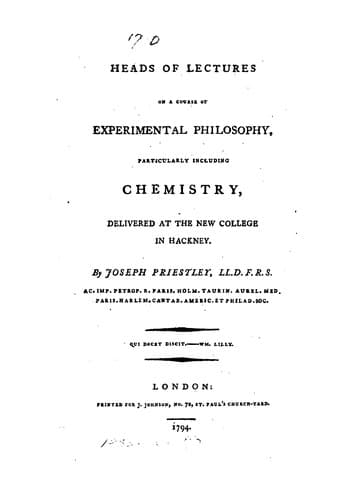
Heads of Lectures on a Course of Experimental Philosophy: Particularly Including ChemistryPriestley, Joseph
Philosophy
Heads of Lectures on a Course of Experimental Philosophy: Particularly Including Chemistry
Priestley, Joseph
Chemistry -- Early works to 1800
If any fluid, as water, spirit of wine, or even mercury, be heated in a
porous earthen vessel, surrounded by any kind of air, the vapour of the
fluid will pass through the vessel _one_ way, while the air passes the
_other_; and when the operation ceases, with respect to the _one_, it
likewise ceases with respect to the _other_.
LECTURE XI.
_Of Liquid Substances_;
AND FIRST OF
_WATER_.
Having considered all the substances that are usually found in the form
of _air_, I come to those that are generally in a _fluid_ form,
beginning with _water_, which is the principal, if not the only cause of
fluidity to all the other substances that I shall place in this class.
Pure water is a liquid substance, transparent, without colour, taste, or
smell; and with different degrees of heat and cold may be made to assume
the three forms of a solid, of a fluid, and of air. Below 32 deg. of
Fahrenheit it is ice, and above 212 deg. it is vapour; so that in an
atmosphere below 32 deg. it never could have been known to be any thing else
than a peculiar kind of stone, and above 212 deg. a peculiar species of
air.
In passing from the state of a solid to that of a liquid, water absorbs
a great quantity of the principle, or matter, of _heat_, which remains
in it in a _latent_ state; and in passing from a state of fluid to that
of vapour, it absorbs much more; and this heat is found when the
processes are reversed. It has been observed, that when water becomes
vapour, it takes the form of small globules, hollow within, so as to be
specifically lighter than air.
The degree of heat at which water is converted into vapour depends upon
the pressure of the atmosphere; so that in vacuo, or on the top of a
high mountain, it boils with little heat; and when compressed, as in
Papin's digester, or in the bottom of a deep pit, it requires much heat.
In the former case the restoring of the pressure will instantly put a
stop to the boiling, and in the latter case the removing of the pressure
will instantly convert the heated water into vapour.
The ease with which water is converted into vapour by heat, has given a
great power to mechanicians, either by employing the natural pressure of
the atmosphere, when steam is condensed under a moveable pistern, in an
iron cylinder, which was the principle of the old fire-engine, or by
employing the elastic power of steam to produce the same effect, which
is the principle of Mr. Watt's steam engine.
Water was long thought to be incompressible by any external force, but
Mr. Canton has shewn that even the pressure of the atmosphere will
condense it very sensibly.
We do not know any external force equal to that by which water is
expanded when it is converted into ice, or into vapour. For though the
particles of water approach nearer by cold, yet when it crystallizes,
the particles arrange themselves in a particular manner, with
interstices between them; so that, on the whole, it takes up more room
than before.
Public-domain text, read in full here on John Shaqi.
Reviews
Reviews
No reviews yet
Be the first to share your thoughts on this work.
Join the Discussion
Join the discussion
Sign in to leave a comment or review.
Sign InorCreate an account