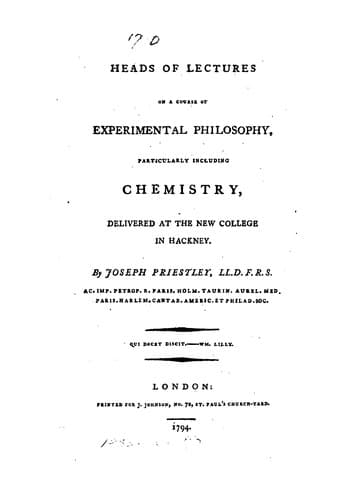
Heads of Lectures on a Course of Experimental Philosophy: Particularly Including Chemistry — John Shaqi
Heads of Lectures on a Course of Experimental Philosophy: Particularly Including ChemistryPriestley, Joseph
Philosophy
Heads of Lectures on a Course of Experimental Philosophy: Particularly Including Chemistry
Priestley, Joseph
Chemistry -- Early works to 1800
The _acid of tartar_ is very similar to that of vinegar. Tartar, from
which it is procured, is a substance deposited on the inside of
wine-casks, though it is also found ready formed in several vegetables.
It consists of the vegetable alkali and this peculiar acid. When refined
from its impurities, it is called _crystals_, or _cream of tartar_. The
acid is procured by mixing the tartar with chalk, or lime, which imbibes
the superfluous acid, and this is expelled by the acid of vitriol. Or it
may be procured by boiling the tartar with five or six times its weight
of water, and then putting the acid of vitriol to it. This unites with
the vegetable alkali, and forms vitriolated tartar; and the pure acid of
tartar may be procured in crystals, by evaporation and filtration, equal
in weight to half the cream of tartar. This acid of tartar is more
soluble in water than the cream of tartar.
This acid, united to the mineral alkali, makes _Rochelle salt_.
Every kind of wood, when distilled, or burned, yields a peculiar acid;
and it is the vapour of this acid that is so offensive to the eyes in
the smoke of wood.
A peculiar acid is obtained from most vegetable substances, especially
the farinaceous ones, and from sugar, by distillation with the nitrous
acid. This seizes upon the substance with which the acid was united, and
especially the phlogiston adhering to it, and then the peculiar _acid of
sugar_ crystallizes. Thus with three parts of sugar, and thirty of
nitrous acid, one part of the proper acid of sugar may be obtained. By
the same process an acid may be procured from camphor.
The _bark of oak_, and some other vegetable substances, especially
nut-galls, contain a substance which has obtained the name of _the
astringent principle_; the peculiar property of which is, that it
precipitates solutions of iron in the form of a black powder, and in
this manner _ink_ is made. But by solution in water and evaporation,
crystals, which are a proper _acid of galls_, may be obtained.
_Amber_ is a hard semitransparent substance, chiefly found in Prussia,
either dug out of the earth, or thrown up by the sea. It is chiefly
remarkable for its electrical property; but by distillation in close
vessels there sublimes from it a concreted acid, soluble in 24 times
its weight of cold water. Amber seems to be of vegetable origin, and to
consist of an oil united to this peculiar acid.
The acids I shall mention next are of a mineral origin; but being of a
less perfect nature as acids, I shall only just note them here.
_Borax_ is a substance chiefly found in a crystallized state in some
lakes in the East Indies. It consists of the mineral alkali and a
peculiar acid, which may be separated, and exhibited in white flakes, by
putting acid of vitriol to a solution of it in water. This acid has been
called _sedative salt_, from its supposed uses in medicine. It is an
acid that requires fifty times its weight of water to dissolve it.
Public-domain text, read in full here on John Shaqi.
Reviews
Reviews
No reviews yet
Be the first to share your thoughts on this work.
Join the Discussion
Join the discussion
Sign in to leave a comment or review.
Sign InorCreate an account