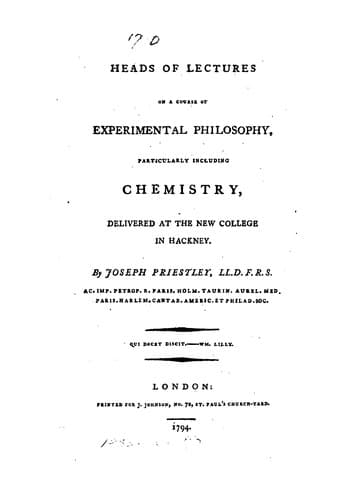
Heads of Lectures on a Course of Experimental Philosophy: Particularly Including ChemistryPriestley, Joseph
Philosophy
Heads of Lectures on a Course of Experimental Philosophy: Particularly Including Chemistry
Priestley, Joseph
Chemistry -- Early works to 1800
Though this is denominated a weaker acid than the nitrous, yet it will
take silver, lead, or mercury, from their union with the nitrous acid.
Upon this principle, a solution of these metals in the nitrous acid will
readily discover whether any water contains the marine acid, the latter
uniting with the metal dissolved in the former, and forming with it, if
it be silver, a _luna cornea_; which being a substance insoluble in
water, discovers itself by a cloudy appearance.
The union of the marine acid with earths forms salts that easily
deliquesce, but with the metals such as are capable of crystallization;
and so also is that formed by the union of this acid to terra ponderosa.
Neither this acid nor the nitrous will dissolve gold or platina; but a
mixture of them, called _aqua regia_, will do it.
The marine acid has a strong affinity to dephlogisticated air, and will
take it from manganese and other substances; and with this union it
becomes a different acid, called _dephlogisticated marine acid_, being
water impregnated with dephlogisticated marine acid air, described
above.
LECTURE XIV.
_Of the Vegetable Acids, and others of a less perfect nature._
The principal of the vegetable acids are the _acetous_ and the
_tartareous_. The acetous acid is the produce of a peculiar fermentation
of vegetable substances, succeeding the _vinous_, in which ardent spirit
it is procured, and succeeded by the _putrefactive_, in which volatile
alkali is generated.
Thus wine is converted into vinegar. Crude vinegar, however, contains
some ingredient from the vegetable substances from which it was
procured: but distillation separates them, and makes the vinegar
colourless; though some of the acid is lost in the process.
The acetous acid is concentrated by frost, which does not affect the
proper acid, but only the water with which it is united. It may likewise
be concentrated by being first combined with alkalies, earths, or
metals, and then dislodged by a stronger acid, or by mere heat. Thus the
acetous acid, combined with vegetable alkali, forms a substance that is
called the _foliated earth of tartar_; and it may be expelled from it by
the vitriolic acid. When combined with copper it makes _verdigris_; and
from this union heat alone will expel it in a concentrated state. The
acetous acid thus concentrated is called _radical vinegar_. Still,
however, it is weaker than any of the preceding mineral acids.
Several vegetables, as lemons, sorrel, and unripe fruit, contain acids,
ready formed by nature, mixed with some of the essential oil of the
plants, which gives them their peculiar flavours. All these acids have
peculiar properties; but it is not necessary to note them in this very
general view of the subject. Like vinegar, these acids may be
concentrated by frost, and also by a combination with other substances,
and then expelled by a stronger acid.
Public-domain text, read in full here on John Shaqi.
Reviews
Reviews
No reviews yet
Be the first to share your thoughts on this work.
Join the Discussion
Join the discussion
Sign in to leave a comment or review.
Sign InorCreate an account