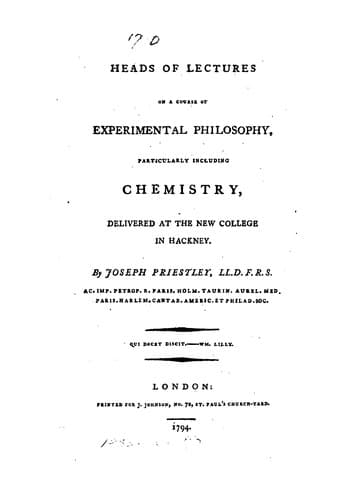
Heads of Lectures on a Course of Experimental Philosophy: Particularly Including Chemistry — John Shaqi
Heads of Lectures on a Course of Experimental Philosophy: Particularly Including ChemistryPriestley, Joseph
Philosophy
Heads of Lectures on a Course of Experimental Philosophy: Particularly Including Chemistry
Priestley, Joseph
Chemistry -- Early works to 1800
Whatever be the qualifications of your tutors, your improvement must
chiefly depend upon yourselves. They cannot _think_ or _labour_ for
you. They can only put you in the best way of thinking and labouring for
yourselves. If, therefore, you get knowledge, you must acquire it by
your own industry. You must form all conclusions, and all maxims, for
yourselves, from premises and _data_ collected, and considered by
yourselves. And it is the great object of this institution to remove
every bias the mind can lie under, and give the greatest scope to true
freedom of thinking and inquiry. And provided you be intelligent and
virtuous men, and good citizens, it will be no cause of regret to the
friends of this institution, if, with respect to _religion_, or
_politics_, you adopt systems of principles, and maxims of conduct, very
different from theirs.
Give me leave, now that I am addressing you as _young men_, and young
_students_, to suggest a caution on a subject, of the importance of
which it is hardly possible that you should be sufficiently aware,
because it is only impressed by that _experience_ which you have not yet
had. I mean that degree of vanity which generally accompanies the
acquirements that diligent persons of your age make in places of liberal
education, and the contempt they are too apt to entertain for those who
have not made the same proficiency with themselves. And I assure you,
that in the observations I shall make on this subject, I have no view
whatever to any thing that I have observed, or heard, of any of you in
particular. But I have been in your situation myself, and I know the
importance of these observations to students in general.
You are now at an age in which young persons usually make the most
sensible advances in knowledge, and in which the understanding appears
to ripen the most rapid manner. You are able to say every year, every
month, and almost every day, what particular advances you have made, and
how much you know more than you did before. And being taught, and
accustomed, to express your thoughts in writing, you find yourselves
qualified to do this in a manner of which you had no idea, or
expectation, but a little time ago. You also perfectly remember what you
have so recently learned, and many respects may be more particular and
exact than even your tutors themselves.
Public-domain text, read in full here on John Shaqi.
Reviews
Reviews
No reviews yet
Be the first to share your thoughts on this work.
Join the Discussion
Join the discussion
Sign in to leave a comment or review.
Sign InorCreate an account