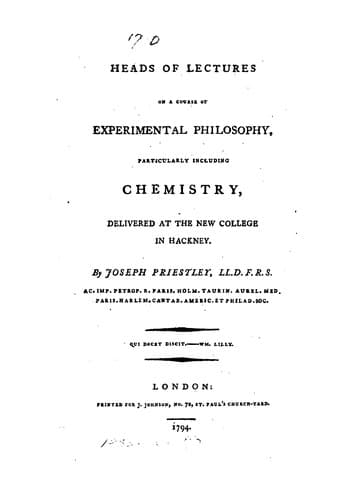
Heads of Lectures on a Course of Experimental Philosophy: Particularly Including ChemistryPriestley, Joseph
Philosophy
Heads of Lectures on a Course of Experimental Philosophy: Particularly Including Chemistry
Priestley, Joseph
Chemistry -- Early works to 1800
The almost unavoidable effect of this is a high idea of your own powers
and attainments, and too often a proportionable contempt of those who,
not having had equal advantages, cannot do what you are easily capable
of. A certain degree of vanity is, therefore, excusable in young
persons; and, indeed, it is by means of it that they are excited to
exert themselves in a manner that they would not otherwise have done.
But be careful that this temper be not indulged to excess, for it will
then be found to have serious ill consequences; the least of which is
the precluding future improvement, from being already satisfied with
yourselves, and conscious of a sufficient superiority over others.
The foundation of this self-conceit, on account of literary attainments,
will be found to be extremely weak. In fact, we learn more before the
period to which you are now arrived, and I hope you will continue to
learn more after it, without its being so much noticed; and the
_ability_ that is discovered in the acquirements which are the subjects
of this vanity is not greater than appears on other occasions. Only they
are not so conspicuous.
What we all learn in the first three years of our lives, is much more
extraordinary in its nature than all that we acquire afterwards. I mean
the perfect use of our limbs, and the elements of speech. What we learn
in a month in that early period of life, could not, if we were brought
up in the ignorance of it, be learned in a year at any subsequent
period. But these acquirements being universal, and what the
circumstances in which we are all necessarily in compel us to learn, it
does not appear extraordinary in any particular individual. Also, the
proficiency that boys make at a grammar school, in which, in general,
the dead languages only are taught (a knowledge of which is commonly the
result of severe application) is too common to be the cause of much
self-conceit. But the advances that are made at places of liberal
education are both less common, and of a more conspicuous nature.
You will also find, if you continue your application to study, that it
is only the elements of science that you can acquire here, and that if
you live many years, they will bear but a small proportion to your
future acquirements. But those future acquirements, in consequence of
their bearing a less proportion to your whole stock of knowledge, will
not be so conspicuous. Thus, though all the buildings that in one year
are added to such a city as London would make a pretty large country
town, they bear so small a proportion to what was built before, that
they are not much noticed; whereas, had half the quantity of building
been erected in a place where no house had existed before, it would have
been a memorable event in the history of the country.
Public-domain text, read in full here on John Shaqi.
Reviews
Reviews
No reviews yet
Be the first to share your thoughts on this work.
Join the Discussion
Join the discussion
Sign in to leave a comment or review.
Sign InorCreate an account