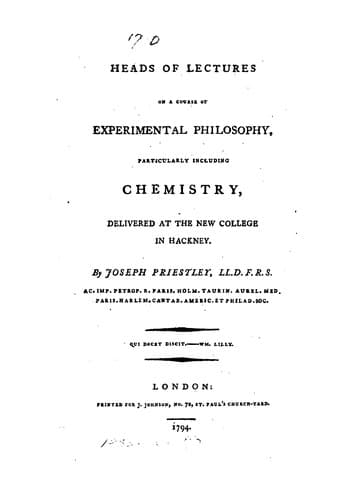
Heads of Lectures on a Course of Experimental Philosophy: Particularly Including ChemistryPriestley, Joseph
Philosophy
Heads of Lectures on a Course of Experimental Philosophy: Particularly Including Chemistry
Priestley, Joseph
Chemistry -- Early works to 1800
If the human calculus be distilled, it yields a volatile alkali, and
something sublimes from it which has a sourish taste, and therefore
called the _acid of the calculus_. It is probably some modification of
the phosphoric acid.
Animal fat yields an acid by distillation, or by first combining it with
quick-lime, and then separating it by the vitriolic acid. Siliceous
earth is corroded by this acid.
LECTURE XVI.
_Of Alkalis._
The class of substances that seems particularly formed by nature to
unite with acids, and thereby form _neutral salts_, are the _alkalis_.
They have all a peculiar acrid taste, not easily defined. They change
the blue juices of vegetables green, or purple, and in common with acids
have an affinity with water, so as to be capable of being exhibited in a
liquid form; though when this water is expelled by heat, some of them
will assume a solid form.
Alkalis are of two kinds; the _fixed_, which have no smell, and the
_volatile_ which have a pungent one.
The fixed alkalis are of _vegetable_ or _mineral_ origin. When in a
solid form, they both melt with a moderate heat, and uniting with earthy
substances, make _glass_. With an intense heat they are volatilized.
Vegetable alkali is procured by burning plants, and lixiviating the
ashes; a purer kind by the burning of tartar, hence called _salt of
tartar_; but the purest of all is got by the deflagration of nitre; the
charcoal uniting with the acid as it assumes the form of
dephlogisticated air, and the alkali being left behind.
Mineral alkali is found in ashes of sea-weed. It is likewise the basis
of sea-salt; from which it is separated by several processes, but
especially by the calx of lead, which has a stronger affinity with the
marine acid with which it is found combined.
Alkalis united with fixed air are said to be _mild_, and when deprived
of it _caustic_, from their readiness to unite with, and thereby
_corrode_, vegetable and animal substances. To render them caustic, they
are deprived of their fixed air by quick-lime; and in this state they
unite with oils, and make _soap_.
Alkalis have a stronger affinity with acids than metals have with them;
so that they will precipitate them from their solutions in acid
menstruums.
The vegetable fixed alkali has a strong attraction to water, with which
it will become saturated in the common state of our atmosphere, when it
is said to _deliquesce_; and having the appearance of _oil_, the salt of
tartar is thus said to become _oil of tartar per deliquium_. On the
other hand, the mineral, or fossil alkali, is apt to lose its water in a
dry atmosphere, and then it is said to _effloresce_. In this state it is
often found on old walls.
Public-domain text, read in full here on John Shaqi.
Reviews
Reviews
No reviews yet
Be the first to share your thoughts on this work.
Join the Discussion
Join the discussion
Sign in to leave a comment or review.
Sign InorCreate an account