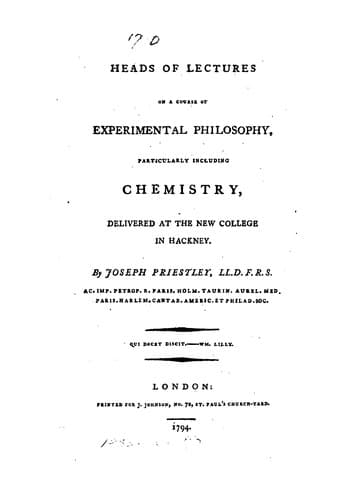
Heads of Lectures on a Course of Experimental Philosophy: Particularly Including ChemistryPriestley, Joseph
Philosophy
Heads of Lectures on a Course of Experimental Philosophy: Particularly Including Chemistry
Priestley, Joseph
Chemistry -- Early works to 1800
Volatile alkali is procured by burning animal substances; in Egypt (from
whence, as contained in _sal ammoniac_, we till of late imported it)
from camel's dung; but now from bones, by distillation. To the liquor
thus procured they add vitriolic acid, or substances which contain it.
This acid unites with the alkali, and common salt being put to it, a
double affinity takes place. The vitriolic acid uniting with the mineral
alkali of the salt, makes _Glauber salt_, and the marine acid uniting
with the volatile alkali, makes _sal ammoniac_. Slaked lime added to
this, unites with the marine acid of the ammoniac, and sets loose the
volatile alkali in the form of _alkaline air_, which combining with
water, makes the liquid caustic volatile alkali. If chalk (containing
calcareous earth united with fixed air) be mixed with the sal ammoniac,
heat will make the calcareous earth unite with the marine acid, while
the fixed air of the chalk will unite with the volatile alkali, and
assume a solid form, being the _sal volatile_ of the apothecaries.
LECTURE XVII.
_Of Liquid Inflammable Substances._
Of liquid inflammable substances the principal is _spirit of wine_,
sometimes called _ardent spirit_, and, when highly rectified, _alcohol_.
It is obtained from vegetable substances by their going through the
vinous fermentation. It is considerably lighter than water, colourless,
and transparent, has a peculiar smell and taste, and the property of
inebriating.
Ardent spirit seems to consist of a peculiar combination of phlogiston
and water; for when the vapour of it is made to pass through a red-hot
earthen tube, it is resolved into water and inflammable air. It is
highly inflammable, and burns without smoke, or leaving any residuum;
and in the act of burning its phlogiston so unites with dephlogisticated
air as to make fixed air.
Ardent spirit mixes readily with water in all proportions, and also with
essential oils, and balsams or resins, which are the same thing
inspissated.
By its affinity with essential oils, ardent spirit extracts them froth
aromatic plants; and these liquors have obtained the name of
_tinctures_.
When the tinctures are distilled, the more volatile parts of the
essential oils, which come over in distillation, have acquired the name
of _waters_; as _Lavender water_, _Rosemary water_, &c. and what remains
in the still is called the _extract_ of the plant. If the tinctures be
diluted with much water, the resinous part of the plant will be obtained
pure, and separated from the extractive part, which will remain
dissolved in the water, while the resin separates from it.
Public-domain text, read in full here on John Shaqi.
Reviews
Reviews
No reviews yet
Be the first to share your thoughts on this work.
Join the Discussion
Join the discussion
Sign in to leave a comment or review.
Sign InorCreate an account